Does the re-election of Donald Trump mark a new phase in US history, toward an attempt to manage systemic crises through more overtly repressive and authoritarian means? Since taking office, the Trump administration and its allies have intensified attacks on the working class, singling out poor and unhoused people, immigrants, trans people and others, while massively expanding ICE and making deportations and militarization increasingly visible. The administration has also moved to consolidate its control over the state by rolling back voter rights and attacking the institutional base of its opponents in the Democratic Party and the section of the capitalist class grouped around the Council on Foreign Relations.
Yet these dangerous developments are not limited to the United States—reflecting instead a global turn towards authoritarianism by elites worldwide struggling to manage the structural crisis of global capitalism. As the University of the Poor Program and the authors in this Journal issue argue, today’s revolutionaries must understand the fundamental economic changes being wrought by the digital technology revolution, which is throwing the old methods of capitalist-class rule into crisis while producing a growing impoverished section of the working class who must “kill the system before it kills them.” The bombardment and deliberate starvation of the Palestinian people is a window into how a depraved global capital views humanity increasingly superfluous to its profit-making.
Amidst these conditions, poor and dispossessed people in the US and across the world must fight back not only by resisting particular policies and episodes of state violence, but also by building our own independent political power on a platform of basic economic survival and working-class internationalism.
This issue of the University of the Poor Journal includes critical reports from the front lines of the Trump administration’s state and policy violence offensive against our communities. Kenia, a leader with Union de Vecinos, reflects on the recent mobilization in Los Angeles against ICE raids. (Leer versión en español.) Catalina Adorno, a leader with Movimiento Cosecha, shares experiences from the fight against detention and deportation in New Jersey. (Leer versión en español.)
With another wave of Medicaid cuts on the horizon, Nonviolent Medicaid Army leaders Nijmie Zakkiyyah Dzurinko, Harrison Farina, John Wessel-McCoy, and Karim Sariahmed offer a playbook of organizing lessons drawn from our history and their experience with the Medicaid Cutoffs Organizing Drive in Pennsylvania, Indiana, and Massachusetts.
The United States has a long and storied history of poor people’s organizing. Yet accessing this history requires breaking through an enforced media blackout, argues Tim W. Shenk in a book review of You Only Get What You’re Organized to Take. Published this spring by Rev. Dr. Liz Theoharis and Noam Sandweiss-Back, this powerful book debunks lies about poverty and wealth, pulling from the authors’ long experience organizing amongst the poor and communities of faith.
Chaplain and organizer Cedar Monroe continues this thread in an interview about the battle for the Bible with Tammy Rosing and Becca Forsyth, organizers from Lancaster County, PA and Elmira, NY recently commissioned through Freedom Church of the Poor. Meanwhile, Moses H.M. offers insights from the pioneering survival organizing of poor trans leader Sylvia Rivera, who pushed the gay liberation movement to commit to social transformation and not just assimilation—a necessary perspective today as even same-sex marriage comes under threat by white Christian nationalism.
As mainstream parties on every continent forfeit their legitimacy by concentrating wealth and power into the hands of a few, new political leaders and formations committed to the working class are gaining momentum, raising the question of political independence and the electoral arena. Looking to Mexico, poet and author Luis J. Rodriguez surveys the rapid rise of the Morena party, with its slogan of “For the good of all, the poor come first”, and explores how revolutionaries should relate to such a vehicle. (Leer versión en español.)
In the United States, two articles in this issue argue that the history of the 1990s Labor Party contains vital lessons for our current moment. Launched in 1996 by 1,400 delegates representing 2 million union members across the United States, the Labor Party adopted a political program and strategy to wean organized labor from the two-party system, advancing the slogan, “The bosses have two parties. We should have one of our own!” The party also attracted marginalized and excluded workers, such as the Farm Labor Organizing Committee, the Kensington Welfare Rights Union, and Michigan Welfare Rights Organization. As Kirsten Rokke and Lenny Brody write, it was these organizations of the poor, with the least to lose in a restructuring of society, who stuck with the Labor Party through the end, while the upper-income unions fled back to the Democratic Party following the election of George W. Bush and the death of longtime Labor Party leader Tony Mazzocchi.
In another article, Willie Baptist, Kristin Colangelo and Phil Wider, longtime leaders in the University of the Poor network, join Rokke in recounting the experience of the Kensington Welfare Rights Union (KWRU) during that time, including its leadership of the 15,000-person march on the 2000 Republican National Convention in Philadelphia, dubbed the “Battle for Broad Street.”
Today, the US working class is defending on many fronts against the current offensive of state and policy violence. To coalesce these fronts into one forward-looking struggle against the ruling-class enemy, we need an organization of revolutionary cadre—a “network of leaders in the struggles of the poor and dispossessed everywhere capable of providing strategic political leadership toward fundamental transformation,” in the words of the University of the Poor Program. The articles in this issue are contributions to the work of developing that network of leaders, with the aim of taking Wall Street and Silicon Valley out of power and putting technology and the state towards the regeneration of the earth, abolition of all poverty, and emancipation of all of humanity.
– Editorial Committee of the University of the Poor Journal
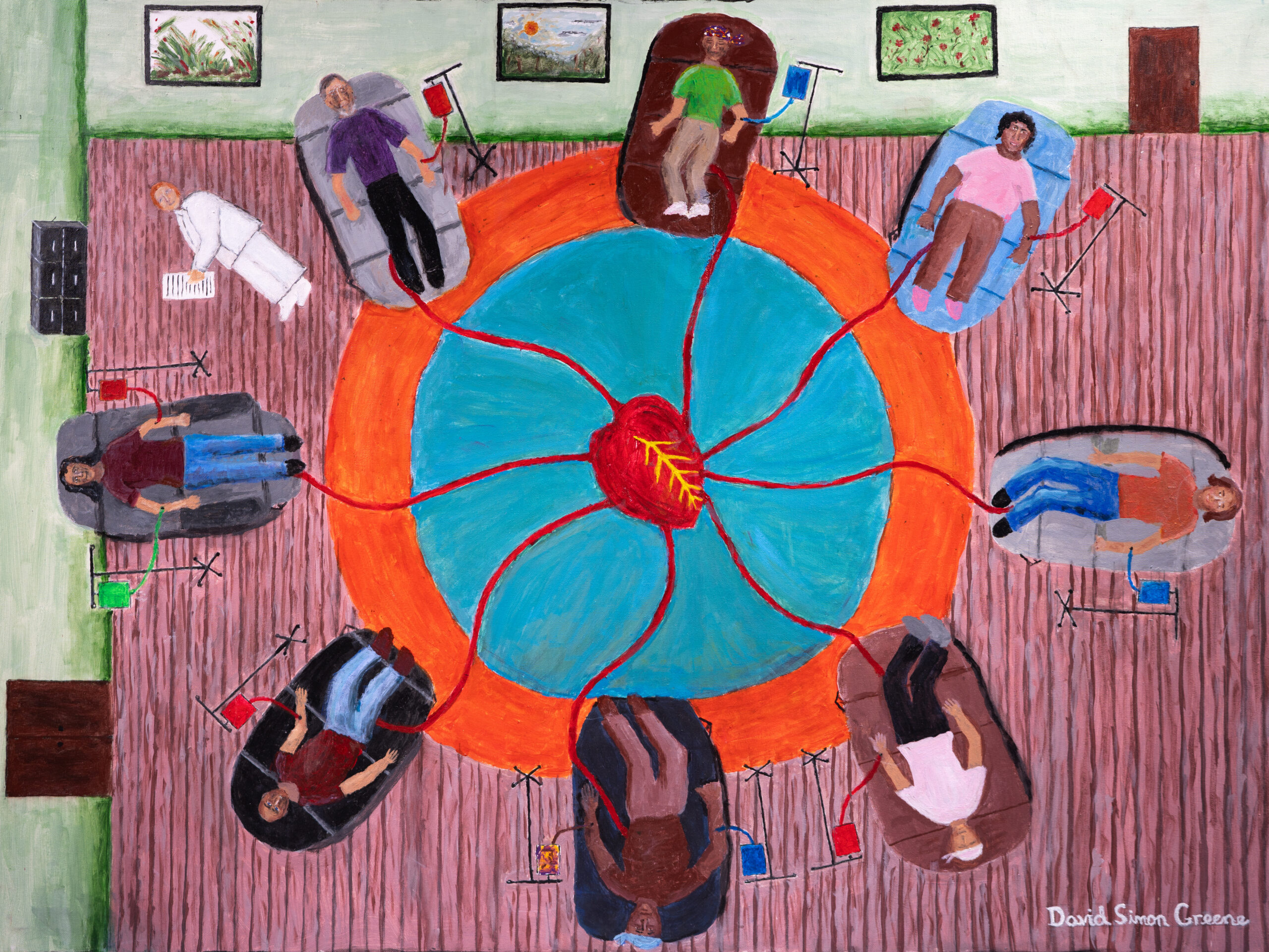
Image: Original artwork by David Greene, used with permission.

Cedar Monroe this is amazing and im very proud of you and how far you have come. Don’t give up, never give up! Keep going the sky’s the limit.