by Tim W. Shenk
You Only Get What You’re Organized to Take is at once a slogan, an organizing orientation, and a teaching tool. It’s also the title of a new book recounting lessons from 30 years of anti-poverty organizing by Rev. Liz Theoharis and Noam Sandweiss-Back (Beacon Press, 2025).
This may be one of the most important books you could read right now. It breaks through the media blackout of poor people’s organizing, supplying essential insights for the work of political and economic change today.
At a time when Medicare, Medicaid, Social Security, and all public assistance programs are under threat, when homelessness and poverty are criminalized, when the rights of trans people, immigrants, students, and the disabled are increasingly violated, Rev. Theoharis and Sandweiss-Back share a big vision: When the poor take bold action together, we can build and wield power, abolish poverty, and lead our society into an age in which our collective abundance is used to meet human needs and heal the earth.
I’m part of the Poor People’s Campaign: A National Call for Moral Revival. In one of our meetings in a small-town church in New York’s Southern Tier, a woman burst out crying. As she told her story of a life of hardship and resilience, many of the rest of us at the meeting were moved to tears as well. She said, looking around the room, “I didn’t know anyone out there cared about people like me.”
When I read this book, I think of her. I think of the millions of people being left out of the political calculus of this country because they’re considered too poor to be reliable voters. When those who have been ignored recognize their worth and their collective power potential, they will shake this country to its core. This book delves into the conditions and consciousness that can make this possible.
The authors say it this way:
“Poor people are not just an oppressed identity group but a social force with untapped power. Because the poor have the least invested in the status quo and the most to gain from transformational change, they are uniquely positioned to rise up and rally others in society to fight for a better and more humane future.”
The text debunks many enduring lies about poverty and wealth, the roots of our problems, and how to go about changing society into one in which everyone can thrive. Right from the front cover, the slogan “you only get what you’re organized to take” dispels the myth that change will come from benevolent charities or from the wealthy, if the poor only wait long enough, ask nicely enough, or make a convincing enough argument. The slogan emerged from the struggles of unhoused organizers, mentors of Rev. Theoharis, who built the National Union of the Homeless in 25 cities in the 1980s and ’90s.
Another lie the authors skillfully challenge has to do with the basis of poverty and wealth in a capitalist society. They refer to capitalism as “an economic system that produces needless deprivation alongside unprecedented abundance.” That is, poverty is neither an accident, nor the will of God, nor the fault of the poor themselves — capitalism multiplies poverty as it multiplies wealth. Under capitalism, those of us who don’t own the means of production — that is, the factories, the banks, the corporations, the land, the AI — have to work in order to eat. We’re the working class, broadly defined. We have to sell our labor-power, our capacity to work, to a capitalist for an agreed-upon amount of time. The capitalist puts us to work and extracts as much as he can from us, and we, if we’re lucky, make enough to get us through the end of the month.
For the first time in human history, technological advances have made it possible to produce abundance for everyone. All poverty, homelessness, and hunger are now “needless deprivation.” This is the crux of the call to build a movement to end poverty led by the poor. Every deprivation that our class now suffers is needless.
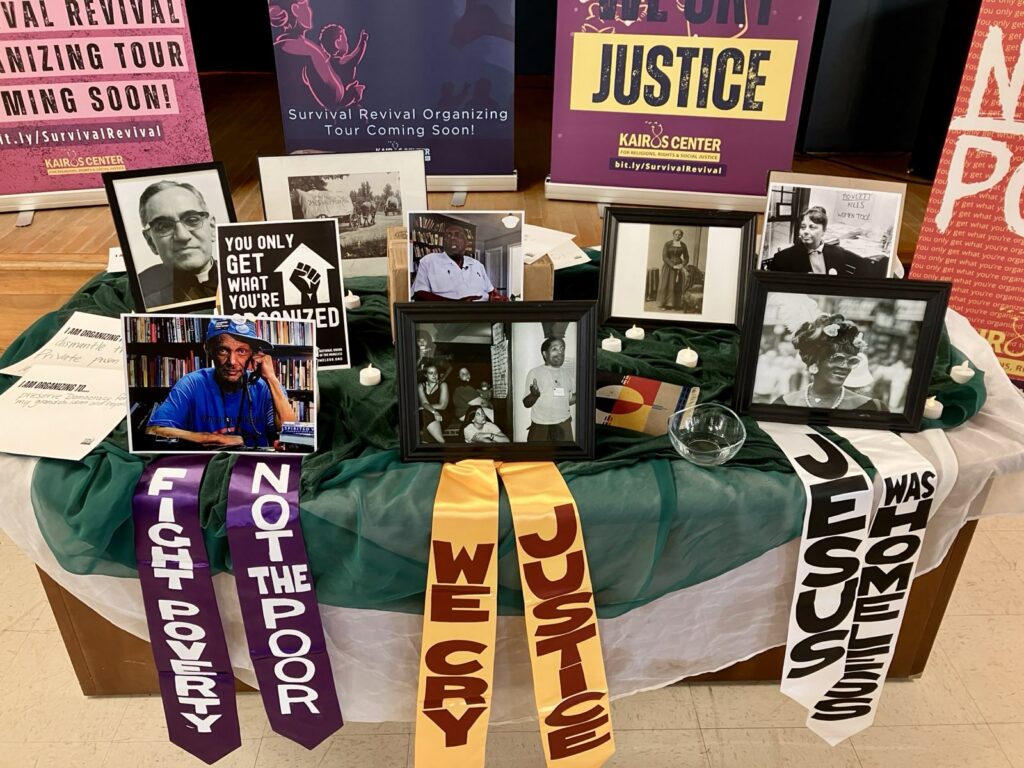
Those who must “kill the system before it kills them,” as the Philadelphia welfare mothers Rev. Theoharis worked alongside once said, are positioned to push the struggle forward until poverty and private property are abolished. Those who can’t get what they need to live in the current system are already objectively revolutionary. That is, they already cannot survive under capitalism, so they have every reason to fight to end it.
In addition, the growing swath of society living just “one emergency away” from catastrophe shares a basic class interest with the poor against the class interests of the billionaires. The problem of our poverty and their obscene wealth is a unifying issue that won’t be resolved with tweaks of policy or the tax code but only with a fundamental transformation of capitalism into something more humane.
Rev. Theoharis and Sandweiss-Back rely on the teachings of the Bible and Theoharis’s 30 years of experience as an anti-poverty organizer as the substance of their moral and material argument for change. It is worth reflecting on both the conversational tone and the grounding in deep spiritual values. The book should be read as a primer on how to speak to the American people.
First, the book demonstrates how to use personal narrative. We communicate best through stories. Listeners can be moved when a speaker makes the effort to connect with them, sharing elements of their life and building on common values, hopes, fears, and vulnerabilities. A speaker who establishes credibility through personal experience, and who can teach through story instead of just quoting facts and figures, can be particularly persuasive. You can dispute a statistic or a concept, but you can’t dispute someone’s life story.
The book opens with a life story. Liz Theoharis, a college student, has lost the seats to the van she borrowed from the community service agency where she works. She has been driving midnight circles around West Philadelphia picking up abandoned furniture for her unhoused friends associated with the National Union of the Homeless. When she circles back to where she left the van seats, they’re gone. She has to fess up to her boss.
This story situates Theoharis not as a stuffy reverend who hides behind her pulpit and vestments but as a fierce, committed, and fully fallible human being. As the story unfolds, it shows a longtime connection to the struggles and insights of the organized poor. From the opening pages, readers have an emotional reaction. They are invited to identify with the young Theoharis as she grapples with what to do about poverty amidst abundance, navigating right and wrong while still having to answer to formal institutions as she takes late-night action on behalf of the city’s most needy.
Later, the authors do share many facts, figures, and statistics. These numbers hit harder because they don’t come up front but as supporting evidence to what readers are already learning through stories of organizing.
Second, the book reveals a religious strategy. The book chronicles a “Battle for the Bible” in the United States in which elites have wielded the holy text as a weapon, developing White Christian nationalism as part of their strategy for building and maintaining power. On the other side, working-class struggles have drawn strength and clarity from Jesus’s anti-imperial resistance and have mobilized wide sections of society based on moral and spiritual values.
The authors aren’t trying to get you to go to church. But they do want you to understand that any political movement from the bottom must engage people’s souls, not just their minds, to counter the advance of White Christian nationalism, now firmly installed in the halls of power.
You Only Get What You’re Organized to Take is an accessible manual for organizing today. Rev. Theoharis and Sandweiss-Back encourage us to dig in, following the Black Panther Party and others to develop “projects of survival” to meet our communities’ material needs while learning as we lead and teaching while we fight. Things will likely keep getting worse, they warn. Needed orientation can come from studying how the poor have organized themselves to take care of each other and fight for revolutionary change.
Get your hands on this book, but don’t keep it to yourself! Its rich lessons are ripe for discussion in families, congregations, and organizations. You Only Get What You’re Organized to Take is an invitation to study together, sing and pray and grieve together, organize together, and take back what was stolen from us — take back our dignity and take back our humanity — we have a world to win!
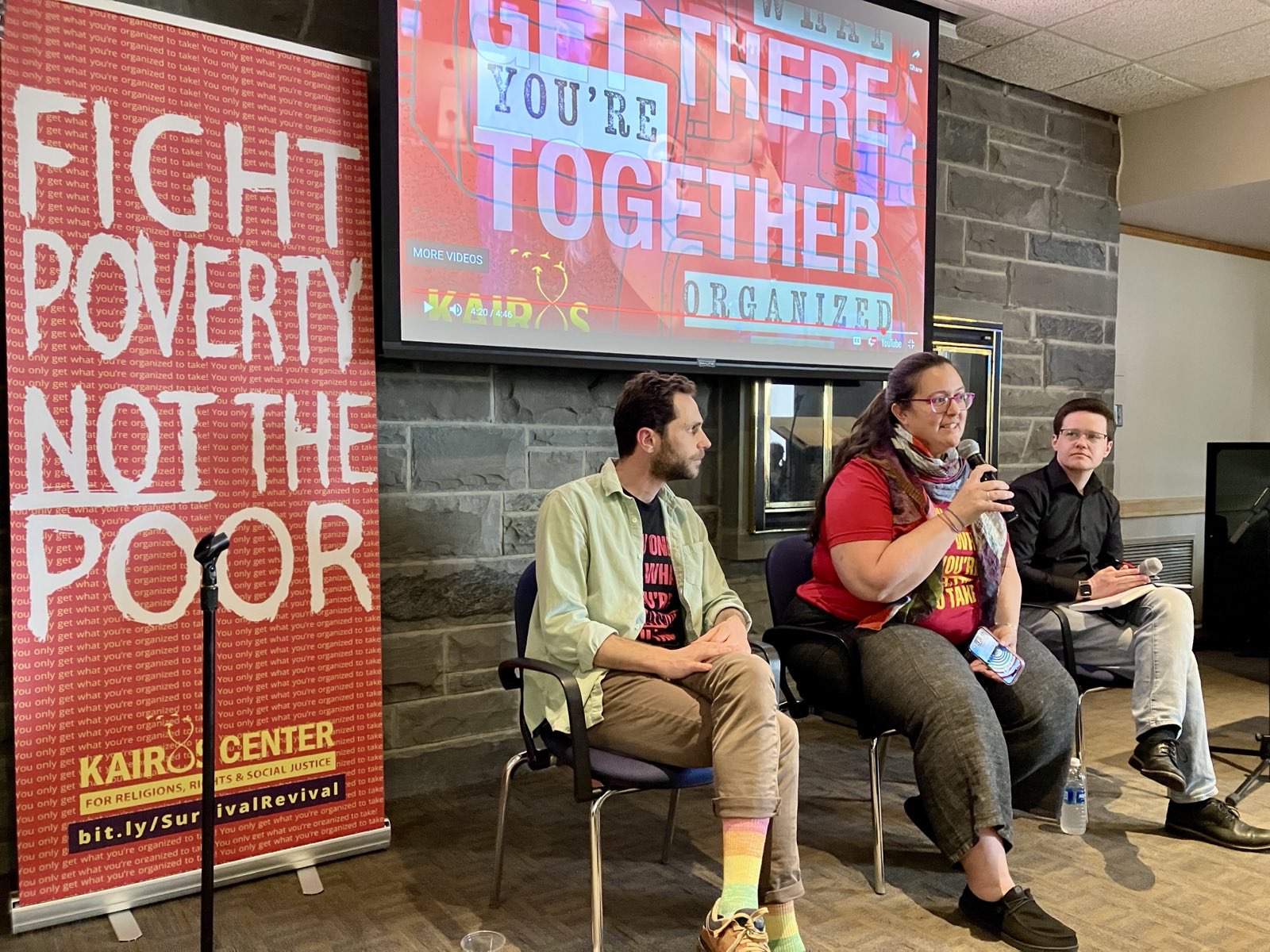
Watch a short video of Rev. Liz Theoharis and Willie Baptist explaining the significance of the leadership of poor and dispossessed people in a movement to fundamentally transform society. In it they announce the launch of a Survival Revival, a bold new organizing drive among the poor. Find out more about the national book tour.
—
Tim W. Shenk is a member of the University of the Poor Journal’s Editorial Committee. He lives in Ithaca, NY.