An interview with Catalina Adorno
Immigrants are prominent among groups in the United States being blamed for the country’s struggles. A false scarcity narrative justifies the kidnapping, detainment, and removal of immigrants and slashing social services while the nation’s wealthiest enjoy nearly a trillion dollars in tax cuts. In response, the country has seen an upsurge in organizing to protect immigrant families.
The University of the Poor Journal’s Sheilah Garland-Olaniran sat down virtually with Catalina Adorno, a leader with Movimiento Cosecha, an organization fighting for the permanent protection, dignity and respect for undocumented immigrants in the U.S. Sheilah is in Chicago; Cat is in New Jersey. The following interview has been edited for length and clarity.
Sheilah Garland-Olaniran: Good morning, Cat, it’s so good to see you! Thanks so much for agreeing to talk at such a difficult moment when there is so much going on. I always appreciate your insights.
Catalina Adorno: It’s great to see you too, Sheilah. These are exactly the moments when we need to be making time to talk. So thank you for the invitation.
SGO: Absolutely. First, I am curious about what you are seeing there. What seems to be the overall motion of those fighting to protect immigrants in relation to the unfolding political situation and the moves of this current administration?
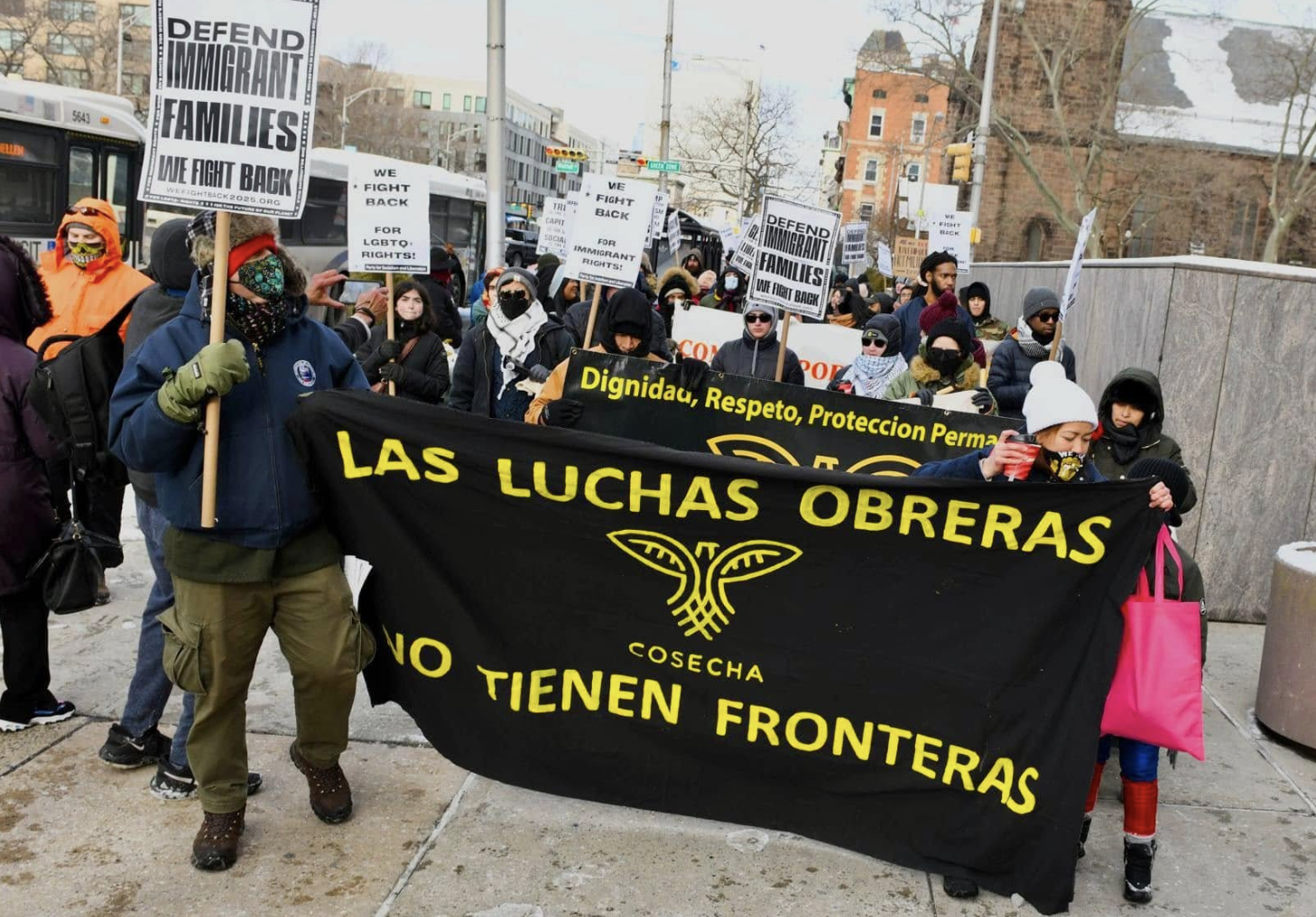
CA: Right now most folks on the ground are focused on defending and protecting the immigrant community at risk of detention and deportation. A lot of work is being done by canvassing neighborhoods and businesses, giving out Know Your Rights information, as well as having community meetings where folks are informed of their rights and what to do if they come in contact with agents of the state.
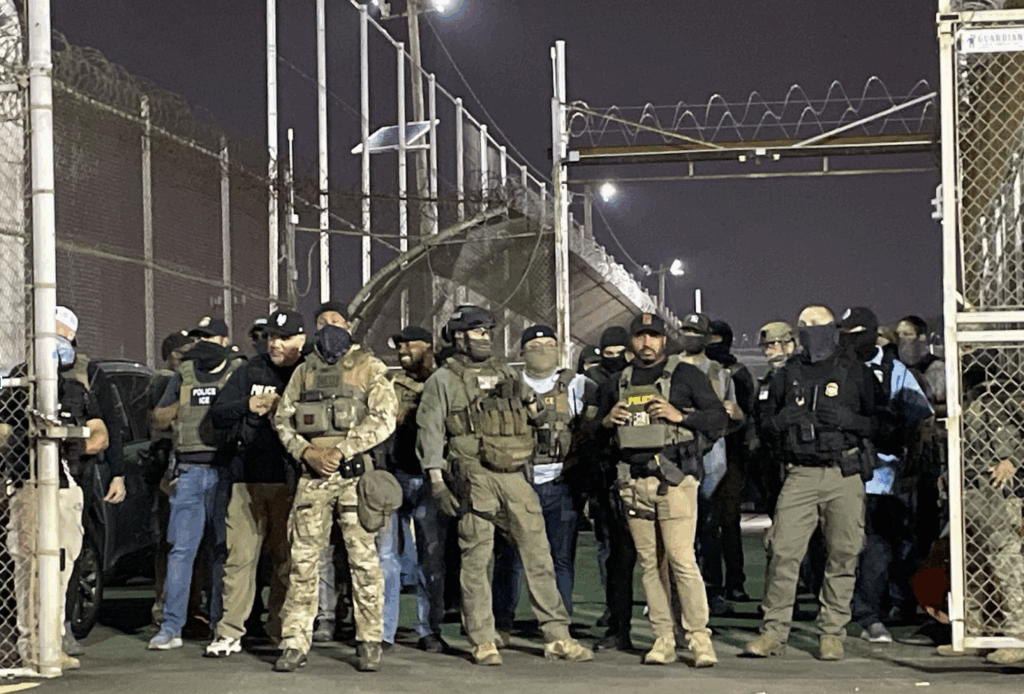
Part of that education work includes identifying immigration officials, since it’s no longer just Immigration and Customs Enforcement, or ICE, taking people. Other agencies like HSI (Homeland Security Investigations) and ERO (Enforcement and Removal Operations) are also acting as immigration agents, and sometimes it’s just people in plain clothes and masks. We have no way of knowing who those people are, if they’re officials or just bounty hunters who get paid when they take someone.
A large part of the work has been forming rapid response networks with volunteers who can be mobilized when an ICE raid is happening, so that these volunteers can show up and attempt to keep officials from taking people.
SGO: Here in Chicago, there are hundreds of folks volunteering for rapid response. We have an alderperson who we do a lot of work with, especially through the Union of the Homeless, who made an Instagram post recently saying, ‘Now is the time for projects of survival.’ She was basically saying that we have to connect with each other and keep going through this dark period. There is also discussion in the city administration to have Chicago police arrest masked folks who are caught kidnapping people in the streets. There are these efforts underway because we have a mayor who has made strong commitments to protecting everyone who lives in Chicago. We’re a sanctuary city in a sanctuary state. But federal agents are still grabbing people. Chicago has been made ground zero, along with Los Angeles, for the attacks on immigrants.
CA: It’s interesting hearing what’s going on in Chicago. New Jersey is a sanctuary state, too. The mayor of Newark, Ras Baraka, and Congresswoman LaMonica McIver have been vocal in trying to show support and concern for their constituencies, resulting in their arrest and indictment, respectively, in May. And yet there has not been a strong stance from our governor or our senators to protect our communities. So the fighting against what ICE is doing in the streets has been left to us. It’s regular working-class people seeing what’s going on and wanting to do something about it.
Trump’s ‘big beautiful bill’ – which is pretty much only beautiful for billionaires – just passed the Senate. The bill includes $45 billion to expand detention centers, and $30 billion more for ICE. So we know they are planning to keep increasing this activity. It’s hard to grasp how much worse things could get with all of this new funding.
A new detention center opened up on May 1st, two months ago, and the capacity was supposed to be in the range of 1,000 to 1,200 beds. But what we’re hearing from inside and from family members is that they’re packing in more people above capacity.
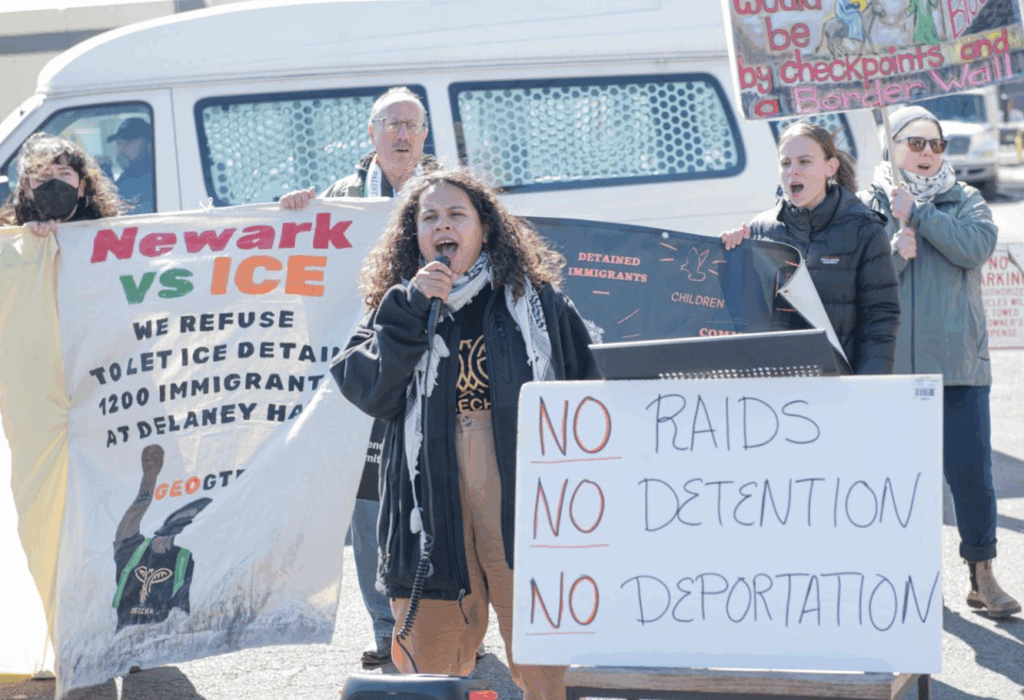
Where private detention centers are being opened with their million- if not billion-dollar contracts, work is being done on locating where folks are being detained and helping them connect with family or loved ones on the outside. There have been vigils or community presence outside every day since the center opened.
Last month when I was outside Delaney Hall, I heard a story of a woman being held inside who was taken a few days after giving birth. Her stitches broke when she was being taken, and no one had heard from her since she had been taken. These are the cruelties that are happening that people may not know.
In Cosecha we’ve been fundraising money to put money in commissaries so that folks in detention can call their families, or to buy food. We have heard stories of folks at the Elizabeth Detention Center, which is the other private detention center in New Jersey, being fed one meal a day consisting of a slice of bread and water. At Delaney Hall, food was being withheld completely. It’s horrifying.
I want to make sure people understand that in every step in the detention process, there is profit being made. Private for-profit detention centers get paid by the federal government for every person they are holding, so there is an incentive to overcrowd the facilities. There is an economic incentive to not feed people and to extort people for every little thing, like charging five dollars to make a phone call.
In the midst of all of this, we’ve been trying to connect families to resources and each other, pointing them to trusted immigration lawyers and other services. We’ve been trying to organize families and set meetings where they can meet each other and connect, since they’re going through the same experience.
In some cases, families have given interviews or have spoken at press conferences about the conditions their loved ones in detention are suffering, so as to bring more insight into the cruelties that are occurring.
What you were saying about projects of survival is happening here, too. Rapid response volunteers are not only responding to ICE sightings, but they’re also taking up very necessary daily tasks. Volunteers are delivering groceries to people who are scared of leaving their homes, as well as taking their kids to school.
In June we were able to raise and distribute about $8,000 to families who have someone who has been taken by ICE. We’ve also started doing accompaniment to people’s court check-ins. In New Jersey in addition to New York City, we’ve now heard of people being detained when they appeared at their regular court date, so we want to make sure folks have community support when they go in. Lawyers are also demanding to have these check-ins online because ICE is showing up at the courts.
SGO: It sounds like you are figuring out a lot. How do you understand your relationship to people’s needs and demands in relation to the political direction of how things are going?
CA: A lot of the demands on the ground are what we might refer to as ‘negative demands.’ By that I mean, NO raids, NO detentions, NO deportations, and abolish ICE and prisons. The demands reflect more what people don’t want rather than what we do want to see in the future, which I understand because right now folks are being attacked constantly. So the instinct is to defend and protect ourselves from attacks.
And the attacks are getting more aggressive. In June, we were outside of Delaney Hall because we heard they were going to be bringing more people in. We were also wanting to support the activity going on inside the detention center, because people were protesting the conditions. They were not being allowed to shower, and being withheld food. So people inside started a riot that escalated and resulted in four people escaping.
So we were outside, and all of a sudden, ICE agents and other officials including local police and the FBI just came at us. They started pushing us around and dragging people on the ground. I have a picture of them pointing guns at people. One ICE agent had my brother in a choke hold. The level of physical aggressiveness is something we hadn’t seen before.
This isn’t directly a demand, but for a lot of the parents I have met, their biggest concern right now is being separated from their children. Some are making plans for what to do in case one or both parents get taken. And some are already dealing with separation of a parent and trying to figure out how to move forward, especially when the parent detained was the primary breadwinner of the family.
SGO: It’s scary how this is ramping up. In addition to that sort of violence by agents on the streets, it appears the Trump administration is trying to remove due process. What would that do to the work you’re doing in the immigrant community?
CA: It’s great that people are talking about due process, but there has never been much due process for immigrants to begin with. A large part of the immigration process has always been discretionary, or just doesn’t exist. For example, the right to an attorney or to make a phone call after an arrest is not something granted to immigrants when they get detained. Or having to go in front of a judge to appeal or make a case: that’s also not something always granted. So this isn’t new with Trump.
SGO: That’s a great point. There is a tendency right now to focus on Trump, but this is bigger than the current administration. Democratic administrations have also greatly expanded the border and detention industrial complex. And now we are in this moment of contraction of the labor force, where digital technology and AI are replacing humans in every industry. If there is less demand for labor, do you see an incentive on the part of the ruling class as a whole – not just the Republicans – to try to control or even eliminate what they consider to be surplus populations?
CA: Yes. Immigration policy tends to follow the economy. When more workers are needed, immigration policy becomes more welcoming to immigrants, or at least what they call enforcement gets more lax. But now like you say, with where the economy is, the ruling class has to find a scapegoat to turn people against. That’s immigrants, that’s trans folks. They have all of their lies about us to keep people from seeing the reality, which is that the rich keep getting richer, and the whole working class is under attack to squeeze as much out of us as possible.
That’s where I want to broaden this conversation. Immigrants are not just an identity category, we’re part of a global class of impoverished people whose wealth is systematically stolen from us by the billionaire class. We’re not poor because we’re immigrants, we’re immigrants because we’re poor. So I think it’s important to talk about how these attacks on the immigrant community are an attack on the working class, or the poor and dispossessed as a whole.
For one, these attacks create fear in immigrant workers, which means they’ll be more likely to go back into the shadows and lie low rather than organize and fight back. This affects everyone when it comes time to organize in your workplace or in the community, if you have a whole section of the population that is unable to show up. Also, these attacks on the immigrant community will also translate to more repression against other workers when they speak up.
Going back to the budget bill being passed, there is a real connection to the cuts to Medicaid and food stamps that are in this bill. The poor are disposable to them, whether you were born in this country or not. Why would the ruling class allow public money to go to healthcare to keep us alive if they’re not going to profit by exploiting our labor? They would rather just take that money directly in the form of a tax cut. Sorry, that may sound cynical.
SGO: Maybe so, but the truth hurts sometimes. AI has this enormous capacity to permanently replace labor from all sectors. They are attacking so many different groups – students, professors, doctors. They’re looking for ways to denaturalize citizens. Scientists are fleeing to Europe. Because so many attacks are coming at once, we can tend to be forced into a defensive posture, like, ‘How do I save my life? How do I eat?’ Those things can feel like a priority over the idea of, ‘How do I join together with others to get this monster off our backs?’ Do you see any possibilities for conscious political action and activity? Do you see examples of unity right now?

CA: Yes, there is unity being fostered across sectors. We have been seeing that among pro-Palestinian organizers and immigrants. Pro-Palestinian organizers and activists are also being detained. Mahmoud Khalil was held in New Jersey before he was transferred to Louisiana. So folks were really making those connections across these struggles that might have otherwise seemed like they were separate.
Solidarity has been happening, but more is still needed. Overall, we have more work to do in educating people that attacks on immigrants are attacks on our whole class. And it’s funny to say this when there is so much to be done on the ground, but we need to study more. We need to know history, and we need to study our enemies in these fights. Where is the ruling class united, and where could we drive a wedge between them? What are the issues that can unite immigrants and non-immigrants against the ruling class? All of these things are essential for us to know right now.
SGO: Very much agree. Here’s to more connecting, comparing notes, and of course studying and learning together to strengthen and broaden our struggles. Thank you so much, Cat, for taking the time.
CA: Thank you, Sheilah.
Catalina Adorno is a Mexican immigrant and a member of the University of the Poor and Movimiento Cosecha.