The August 11, 2025 explosion at U.S. Steel’s Clairton (Pennsylvania) Coke Works comes 118 years after journalist William Hard wrote “Making Steel and Killing Men,” a groundbreaking report on U.S. Steel’s South (Chicago) Works where 46 men were killed in a single year.
This article is part of the series, “Three Organizers Speak on the Clairton Coke Works Disaster.” Read the pieces by Anthony D. Prince and Nijmie Zakkiyah Dzurinko.
By Larry Regan
I was president of Local 1014 at the Gary Works in 1987 when U.S. Steel took a reckless and casual approach to safety. We had two men killed who were using argon gas on a maintenance. Job. The gas is invisible and they had no respirators. When other men tried to rescue them, those men were overcome. Like we told the newspapers at the time, it was because U.S. Steel was combining jobs and cutting spending on safety.
Mike Wright, our International Union Safety Director came out and said the accident was a direct result of the company running thin on maintenance. My Safety Chairman, Willie Moore, who later became President of the local, told them that U.S.Steel (which was called “USX” at the time) was not accurately reporting injuries and telling people who got hurt to stay at work so that the mill could keep a low lost workday rate.
In fact, this was the same year that at the U.S. Occupational Safety and Health Administration (OSHA) had cited U.S. Steel for willfully underreporting injuries at the Clairton Coke Works.
In 1988 we walked out of a company-union joint safety conference at a theater in the Raddison Hotel in Merrillville to protest how our guys were being exposed to old asbestos pipe insulation in the 210-inch plate mill. It was falling all over the floor and they had some guy with a broom and a shovel picking it up which was totally against the regulations.
I told the local papers how they were exposing our workers, about what would happen if a wind came through that building and blew those deadly fibers all over the plant. I told them it was hypocrisy for U.S. Steel officials to be sitting there at the Holiday Star Theater talking about safety when they had this casual approach to safety inside the plant. And I told them that we’d had other incidents such as a toxic gas leak on the blast furnace that was over the prescribed parts per million and it took hours for them to correct the problem.
We had sulfur dioxide coming off our coke ovens and the whole region from Michigan City, Indiana to South Chicago was known as the cancer capital of the world.
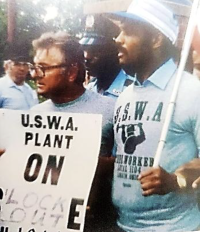
These were some of the issues that we faced when we were negotiating our contract in 1986 when U.S. Steel locked us out for six months. They were trying to starve us out and we got hold of purchase orders showing that they were stockpiling small arms and tear gas. When the
UAW autoworkers came to support us, they brought 400 gas masks with them. I told the newspapers, “What does U.S. Steel want? Another Homestead massacre?”
(In 1892, during a bitter strike against Carnegie Steel — later named United States Steel — ten men were killed when thousands of Homestead steelworkers were fired upon by Pinkerton detectives.)
We brought Jesse Jackson out to support us. He was running for president at that time. We had a big march to the plant gates with the steelworkers and 200 ministers. Jesse pointed to a building on the other side of the gate. I told him it was the main office of the mill. So Jesse just walked right in and we followed. Georgia Brooks was in the back of a pick-up truck with a sound system and she gave the most beautiful rendition of the Battle Hymn of the Republic I ever heard.
Right now, the current administration is trying to get rid of federal agencies that are supposed to protect workers on the job. As part of the proposed fiscal year 2026 budget, the Trump administration has moved to eliminate the U.S. Chemical Safety and Hazard Investigation Board (CSB) which is currently investigating the Clairton Coke Works explosion.
Experts and safety advocates argue the CSB’s role is unique. It is supposed to focus on the “deeper root causes” of accidents, such as systemic failures and workplace culture, even though we have to push them to do so. We have to fight to keep these public agencies and make them do what they’re supposed to do. Otherwise, it might be left entirely to the owners of the nation’s mines, mills and factories where workers have been injured and killed – owners like U.S. Steel. We can’t let that happen.
The explosion that killed and wounded my fellow steelworkers in Clairton should never be forgotten. The struggle for human life over profit must go forward.
A Phoenix needs to rise from these ashes.
Larry Regan is the former President of United Steelworkers of America Local 1014 at the Gary (Indiana) Works of U.S. Steel; He recently retired as Vice-President of Teamsters Local 142 and is a Senior Advisor to the National Union of the Homeless. Photo: Larry Regan (L), Jesse Jackson (R).