By Elizabeth Blaney, Union de Vecinos, Eastside Chapter of the LA Tenants Union
During election season the question of democracy always arises. What is democracy? How do we practice it? The United States tries to impose its version and definition of democracy on the rest of the world by lifting up its practice as the model. When a country does not follow the standards the US deems acceptable, it is dubbed corrupt, fraudulent and the country’s leadership called into question. The litmus test for US democracy is “If you serve our interests you are democratic, but if you don’t, you could be sanctioned or suffer other consequences.” Sovereignty does not enter into the equation. This is the exact practice that has been applied to Venezuela over the last 25 years.
I had the opportunity to be an international observer for the July 28, 2024 Presidential elections in Venezuela. I reviewed policies and procedures, witnessed voting at 4 polling centers in different parts of Caracas in both neighborhoods favoring and not favoring the current President. I spoke with voters, government officials, and representatives from various political parties. I share my experience and what I witnessed in that process.
Fraud Prevention
Venezuelans place a high priority on fraud prevention. There are 16 audits that take place at different levels overseeing the voting systems, voter registration, voting machines, and process for implementation. All parties representing candidates, and in this election there were 10 candidates, have the opportunity to review and be witness to the audit. They sign off on whether they agree with the results of the audit. In this election, all parties, including the US backed opposition candidate Edmundo Gonzalez, signed in agreement. This is a process that takes place before election day.
On election day, you can only vote at your polling center. No provisional ballots are allowed. No mail-in ballots are allowed. At first, I thought that this would decrease participation but what it actually does is ensures that fewer hands are touching the ballots and all votes are processed the same way regardless of what state in the country you vote in. In the US not every vote is counted – particularly provisional ballots.. A provisional ballot only matters if there is a certain margin of error or a recount. Venezuela’s practice of voting only at your assigned polling center ensures that every vote counts and supports election integrity.
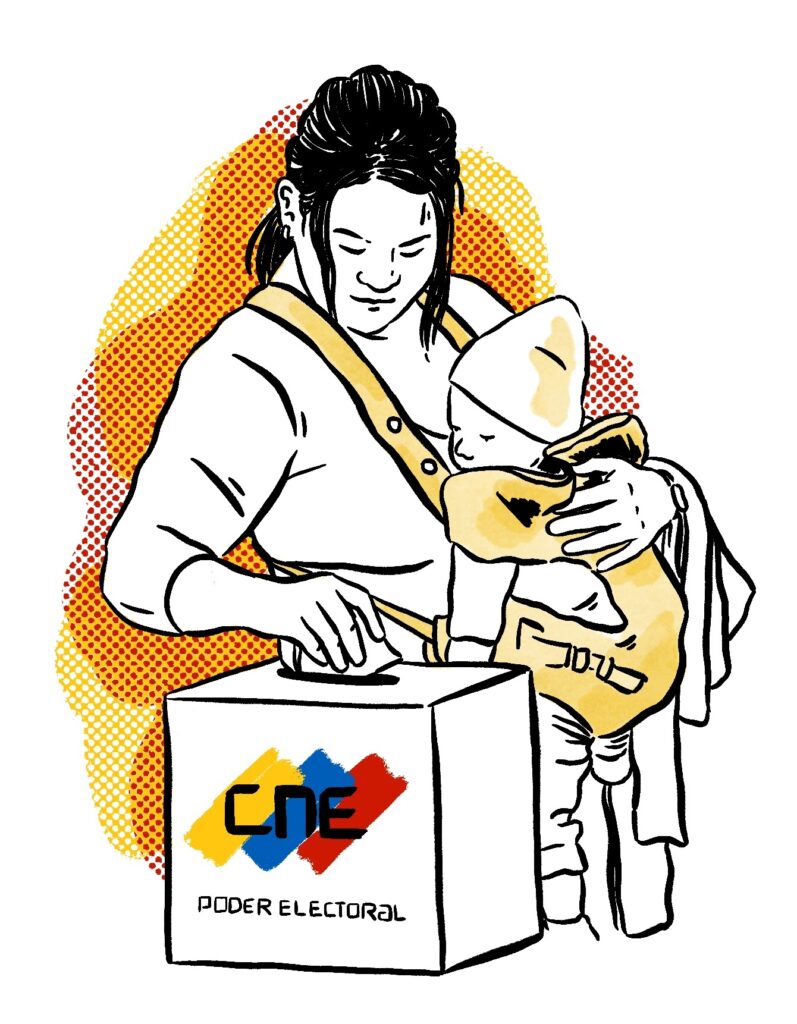
In Venezuela, you must have your ID to vote. After showing your ID, your fingerprints are registered in the system as an additional form of verification. This is systematic at every polling center in the country. In the US, we do not have a national standard for voter identification. Different states implement different practices. Some states require ID, others just a signature. Some states still use discriminatory identification practices intentionally aimed at people of color to make it more difficult to vote. Venezuela’s uniform national voter identification process promotes equal access to voting at the polls.
Once you are at the voting center, you are assigned a room to vote in depending on the last numbers of your ID. You go into the room and show your ID, scan your fingerprints and then are sent to the next table to vote on a tablet (electronic voting machine). To address issues of literacy the ballot has pictures of all the candidates and their names in writing. You select the candidate you wish to vote for and hit submit. To ensure your actual choice was recorded, you print out your vote and compare it to what you selected. You are then sent to another table where you deposit your paper printout of your vote in a box after again scanning your fingerprints. This process not only is another step in fraud prevention but also promotes transparency in ensuring who you voted for is what got recorded.
Transparency
When the voting centers close, the counting of the ballots begins. The team of 5 that runs the voting center was randomly selected via a lottery system from the pool of registered voters. This reduces the risk of only candidates from one specific party being the ones managing the voting center. Each person has a specific part of the coded key box to make sure that no one or a smaller grouping can open the box or tamper with it during the day.
Any community member is allowed into the voting center to watch the verification of what they call “tally sheets”. These are the counts of the paper print outs of the votes that were deposited in the box. They tally up the number of papers and ensure that it matches what was recorded on the voting machines. Representatives from each political party are allowed to see the tally sheets and take pictures of them. In the US, we are not allowed to watch the counting of our vote and any verification process at this local neighborhood level that our vote matters.
Democratic Participation
Elections are held on Sundays in Venezuela to ensure maximum participation since this is a day when most people do not have to work. There was only one item on the ballot to ensure that it gets the attention it deserves and that other openings for political offices or referendums do not get overshadowed by the Presidential Election and receive an equal opportunity for discussion and debate.
Despite there being 161.4 million registered voters in the United States, only 270 people will decide who our president is in our presidential election. This is not democracy, nor is it a way to encourage participation. In fact it has the opposite effect. Many people do not vote for a Presidential candidate because they do not believe their vote counts. Their vote is already decided by electoral college delegates regardless of how they vote. In the 2016 elections, Hillary Clinton won the popular vote by more than 3 million votes. In 2000, Al Gore also won the popular vote and yet George W. Bush was announced President. However, in Venezuela the popular vote determines who is the president. Nicolas Maduro won the popular vote by 2 million votes. It was audited, investigated and certified by the Venezuelan Electoral Council, which is made up of representatives from the different political parties, and the Venezuelan Supreme Court. There was no fraud. It was a free and fair election.
Conclusion
The charges of election fraud against Venezuela are rooted in the fact that the US needs Venezuela’s socialist government to fail because it puts limits on the ability of the capitalist class to make profits. The US state has launched a hybrid war against Venezuela, refuses to accept the election results of the Venezuelan people and has decided to handpick its own person it wants to recognize as President. That is not democracy. We as US people would not want another country to determine our president. We would actually like the chance to directly elect our own President. But Congressional and Senate leaders have control over electoral delegates and do not want to give up that power to the people.
The US ruling elite and global capitalist class wants Venezuela’s oil. Its media propaganda of lies, its economic torture through the use of sanctions, and its cries of curruption and fraud are all in service of that goal. Venezuela uses the income from oil sales to produce over 5 million homes for the poor, guarantees free health care, and provides free university for students. Its sale of oil serves the poor and working class. The 25 year history of a socialist government and its practice of democracy is a living example of the world in which we should live.


The fingerprinting with mandatory ID may sound contrary to people in the US calling for measures to make voting less restrictive here. But the restrictions made here are a result of manufactured lies about violations of election integrity, made by those who need small numbers to vote for them to win. They are the same ones, along with others within the US ruling class ( Dems and Repubs alike) who would violate the election integrity of Venezuela to disrupt their system. Because of this real threat to election integrity I can see how mandatory ID and fingerprinting would be necessary to assure a democratic result. Also, our election deniers would probably applaud the measures taken in Venezuela, until they found out it was happening in Venezuela.