
By Bruce E. Parry
A capitalist analysis of our age
People should read Age of Revolutions to understand what the class enemy – the capitalist ruling class – is discussing among themselves.
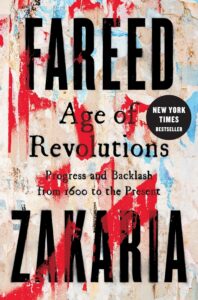
The author, Fareed Zakaria, is a smart guy. He is a Yale graduate and has a Ph.D. from Harvard. He is the former managing editor of Foreign Affairs, the flagship publication of the Council on Foreign Relations (CFR). He writes for the Washington Post and has written for Time, Newsweek and other leading publications. He hosts a Sunday morning talk show and podcast. In short, he is “Mr. CFR.”
In addition, he presents himself as Mr. Progressive. He begins the book with a quote from the Communist Manifesto. Zakaria says he is discussing three things: First, what makes a period revolutionary? Second, what are the consequences of being in a revolutionary era? And third, how will it end? The CFR is debating these issues. It is worth knowing what the capitalist class enemy thinks about these questions.
What is the CFR? The CFR is the Central Committee of the ruling capitalist class. The capitalist class consists of the owners of businesses. Many you’ve heard of like Apple, Amazon, Walmart, Boeing, Berkshire Hathaway (Warren Buffet’s company), Chase Bank, UnitedHealth Group, CVS Health, Exxon, Toyota, Alphabet (Google), Costco, and thousands you’ve never heard of, from big to small. This is ownership of capitalist private property, the basis of capitalism. The class, like many of the companies, is global, but the main instrument of the global capitalist class is the U.S. state apparatus. The capitalist class controls the Executive, Legislative, and Judicial branches of government at the Federal, State, County and Local levels throughout the country.
This class is the most organized, communicative, educated, strategic and powerful class in history. And the CFR is its central hub. The CFR is a think tank but is much more. Its members have, for most of its 100 year history, been the central figures in the presidential administrations of the U.S. government. The military, intelligence, national security, and foreign affairs have particularly been chosen from the CFR. The CFR is where the planning and organization of the capitalist class takes place. It also has a Council of Councils that brings together the leading organizational groups from countries around the globe. It has a local presence in every major city in the U.S. The CFR studies and strongly influences the strategic, overarching interests of the capitalist class at every level.
Despite its power, the ruling capitalist class has its weaknesses. This book, Age of Revolutions, is a discussion of the current age and exposes some of those weaknesses. History and political economy show that we are, indeed, in a profoundly revolutionary period. The economic revolution of microelectronics has presented capitalism with an unsolvable dilemma: the technology being implemented replaces workers in a system that requires those very workers as wage laborers. The system of computerization of production causes there to be an excess, an overabundance, of workers relative to what these businesses need to function. This excess causes wages to sink across the board, increasingly creating poverty.
The electronic revolution is objective. Technological progress moves forward; in fact, capitalism depends on it and generates it. Capitalists are forced by competition with other capitalists, to incorporate the latest technology. If they do not, their cost of production is higher, they lose market share and eventually go out of business or are bought up by larger capitalists. So each capitalist has no choice but to innovate and each innovation leads to the capitalist laying off workers. If they do not, they die. But the profit of capitalists comes from the labor of their workers, from the exploitation of labor, so this creates an existential crisis for capitalism as a system. It is in this sense that the economic revolution has begun an epoch – an age – of social revolution. A social revolution is a period of economic, cultural, social and political upheaval created by the contradictions of the technology – the forces of production – and the fact that capital makes its profit by the exploitation of labor – the relations of production. Marx recognized this when he stated,
“At a certain stage of development, the material productive forces of society come into conflict with the existing relations of production or – this merely expresses the same thing in legal terms – with the property relations within the framework of which they have operated hitherto. From forms of development of the productive forces these relations turn into their [chains]. Then begins an epoch of social revolution. The changes in the economic foundation lead sooner or later to the transformation of the whole immense superstructure.” (Marx, Preface to A Contribution to the Critique of Political Economy)
The working class has no choice but to find work in the businesses privately owned by the capitalist class. The working class has no private property and therefore must find work in order to live. The microelectronic revolution makes it more and more difficult to find a job that pays enough to live. The working class is the Labor Movement. General Baker clarified this when he said,
“The labor movement … is all of those who work by the sweat of their brow, whether you sell mental or physical labor. Some get confused thinking that they’re selling mental labor, they are not workers. Some selling mental or physical work, whether you are working in the countryside or the city. Whether you’re paid by the hour or all at once. Whether you work part time or halftime or not at all. If you once used to work but are no longer able. If you once used to work but are now unemployed. If you wanted to work and can’t get there. All of this represents the scope of the labor movement. And therefore the union movement is only an organized portion of the labor movement.” (General Baker, On Solidarity)
In this current period of social revolution, the poverty of the working class is objective. It has become the fourth leading cause of death in the United States. Eight hundred people die every day from poverty. The healthcare system is fundamentally broken. Homelessness is on the rise; millions of Americans are without housing. The militarization of society is fed by the trillion-dollar war budget. Voting rights across the country are under attack. Our policy, based on the objective laws of capitalism, is to use these issues to unite the poor and dispossessed (those without private capitalist property).
… liberalism means capitalism and the right of capitalists to oppress and exploit labor.
Age of Revolutions discusses the class enemy’s point of view. It is divided into two parts: Revolutions Past and Revolutions Present. In the section on Revolutions Past, Zakaria has hand-picked the revolutions that he wants to discuss. These are bourgeois revolutions that he describes as “liberal.” It is about the emergence of “classical liberalism.” Classical liberalism does not refer to what we call left-leaning do-gooders. Instead, he refers to the historical definition, meaning, “individual rights and liberties at home, freedom of religion, open trade and market economics, and international cooperation within a rules-based order.” In short, liberalism means capitalism and the right of capitalists to oppress and exploit labor.
As we read the book, we need to keep in mind that neither Zakaria nor the CFR, nor the capitalist class can challenge capitalism itself or its basis: private ownership of the social means of production and distribution of the goods and services we need to live. They cannot raise the question of class struggle because that would raise the possibility of the working class battling and even defeating the capitalist class.
Zakaria discusses economic revolutions and political revolutions as if they are directly comparable, as if they simply result from different policy decisions. History has shown that economics underlies the political. Therefore, the correct approach is to study the laws of economics and see how it gives rise to social and political upheaval. An economic law – for example, that under capitalism, the capitalists privately own the businesses and must exploit wage labor – is an objective reality, independent of anyone’s will. That’s not just a policy under capitalism, that’s the basis of capitalism. Different periods of history – Egyptian, Greek, and Roman Slavery, Feudalism and Socialism – have different objective laws. That is why it is so important to study both political economy and history.
The first revolutions he looks at are those in the Netherlands and in England. Both are bourgeois revolutions. The revolution in the Netherlands was the first emergence of the capitalist class as the ruling class and is therefore politically important. What he doesn’t say is that capitalism – in its earliest stages – existed before the revolution and gave rise to it. The revolution in the Netherlands overthrew Feudalism and achieved capitalist rule, but – like many revolutions – the feudal aristocracy defeated some of its gains. The Netherlands is therefore a constitutional monarchy today, a form of capitalism with a king and a parliament.
The same thing happened in England. Capitalism existed before the English Glorious Revolution took place. The capitalists seized power and became the ruling class. Zakaria praises this phase as liberal and therefore enlightened. But, the capitalists fought against the feudal aristocracy, beheading the king. Oliver Cromwell seized power and delayed the eventual reaction of the aristocracy. After Cromwell’s death the aristocracy retaliated, reversing some of the gains of the capitalists. Like the Netherlands, England today is a capitalist constitutional monarchy with a king and a parliament.
… the French Revolution was a classic case of class struggle. It was the first time in history where a nascent working class – the unformed proletariat – emerged as a political force. The revolution became more and more radical…
Then Zakaria discusses the “failed revolution,” by which he means the French Revolution. He considers this to be quite “illiberal.” But the French Revolution was a classic case of class struggle. It was the first time in history where a nascent working class – the unformed proletariat – emerged as a political force. The revolution became more and more radical until the capitalist forces led by Robespierre seized power and defeated – guillotined – the aristocracy. This was a case of the poor aligning with the capitalists to defeat the aristocracy. So thorough was their effort that today there is no king of France. Zakaria includes a discussion of Napoleon, who emerged during the revolution. Napoleon represented the capitalist class, a point omitted by Zakaria.
At the end of this chapter, Zakaria briefly discusses other revolutions he considers failed, including the Russian Revolution of 1917. Other than this, he has nothing to say about the Russian Revolution, the Chinese revolution, the Cuban Revolution, the Vietnamese Revolution, or the Venezuelan Revolution. All are, for Zakaria, “illiberal,” because each of these revolutions raises the question of class struggle. They are examples of the poor and dispossessed – the working class – fighting and defeating the capitalists and establishing forms of Socialism.
After discussing the revolutions in the Netherlands, England and France, Zakaria turns to two economic revolutions, the English industrial revolution and the American industrial revolution. What is left out is that capitalism existed in each of these countries before these revolutions. The capitalist class already existed; they made the political revolutions. Granted, capitalism was relatively undeveloped, particularly in England before the revolution, but it did exist.
The key is that after the English political revolution, a true economic revolution – the industrial revolution – took place. The invention that fostered this revolution was the steam engine. The feudal structure that the capitalists overthrew had been constraining, limiting capital. Once they held state power, the capitalists’ ability to make a profit by exploiting labor unleashed the power of capital and it took off. The steam engine had existed in an early form before the revolution. But profits were to be made; it was refined and made more useful after the Glorious Revolution and caused the development of many other industries. For example, iron and steel were needed to make the steam engine, wood and coal to fuel it. The textile industry, which benefited from this mobile source of power, took off and developed into an international industry which affected the development of the United States.
The American industrial revolution – the next chapter – begins the real analysis of what Zakaria is trying to get at. The country was polarizing over the economics of slavery. When the economy polarizes, every aspect of social and political life polarizes as well. At that time, there was a split in the ruling class. The northern industrial capitalists, led by Wall Street, fought to defeat the southern capitalist slavocracy. Textiles – particularly cotton – were to the world economy what oil is today and the United States was in the midst of it. After the southern states seceded, Wall Street was free to set the conditions for the maximum expansion of industrial capital in the North. For example, they built railroads from coast to coast during the Civil War and completed them by 1869.
The Civil War was the American revolutionary war. The fighting was done by the northern and southern sections of the working class. When the enslaved section of the working class deserted the plantations and joined the Union Army, the unity of the poor whites and poor Blacks was established. After military victory, Reconstruction carried out the revolutionary program. The defeat of the slavocracy and the unity of Blacks and poor white workers allowed the rewriting of state constitutions, the establishment of public education, the democratic election of representatives at the state and national level, and the other gains of Reconstruction.
However, the reality of the world economy – the need for cheap cotton to feed the worldwide textile industry – remained unchanged. The Wall Street capitalists of the North ruled. They made a deal: the Hayes-Tilden Agreement that allowed Hayes to be President but withdrew all federal troops from the South. This empowered the defeated slavocracy to reinstitute slavery under Jim Crow fascism. Reconstruction was defeated. It took almost another century of struggle to defeat Jim Crow. In that period, the U.S. became the biggest economy in the world.
That is not the story Zakaria tells when he writes about the “Real American Revolution.” He all but ignores the Civil War and barely mentions slavery. He mentions the robber barons and the labor unions. In fact, throughout the book the union movement is represented as the labor movement, the movement of the entire working class. He doesn’t see the poor sharecroppers, black and white, or the poor non-union majority of the working class. He diverts attention from the class struggle, substituting the policies that the capitalist class and its supporters implemented. It’s as if the heart of the working class as an economic and political entity, never existed. At the same time, he is drawing attention to this period of American history as an age of revolution.
… he (Zakaria) confuses the root cause – the economic revolution – with the social and political results of that revolution.
In Part II – Revolutions Present – he lists what he sees as four modern revolutions: globalization, the information revolution, the emergence of identity politics and the shifting reality of geopolitics. As with the first section, he confuses the root cause – the economic revolution – with the social and political results of that revolution.
He identifies the information revolution. We call it the microelectronics revolution because it’s all based on microelectronic technology. But he doesn’t develop the reality that microelectronics is applied to every aspect of society, particularly production. In fact, he doesn’t mention production much at all in the book. The new technology is labor-replacing – not labor-saving – which leads to unemployment and falling wages. And it is global. That’s what is making this an age of revolution. But the real consequences, such as poverty and homelessness, don’t make it into the book.
The microelectronics revolution creates the fundamental economic polarity: the polarity between untold wealth and untold poverty. On the one hand stand billionaires privately holding trillions of dollars. On the other hand are the millions of homeless and poor members of the working class. In the U.S. many homeless – even some who are working – are reduced to living on the streets in tents in the richest country in history. These workers own no private property that produces income; they have only their personal property.
The untold wealth means that capital reaches every corner of the world. The workers in Chad, India and Brazil work for the same capitalists as the workers in Europe, Japan, South Korea and the U.S. They face the same capitalist class. Globalization and contemporary geopolitics are governed by the leading instrument of the global capitalist class: the U.S. state apparatus. This includes the U.S. military which has 950 bases all over the globe. There are U.S. troops in almost every country and the U.S. Navy controls the seas to insure capitalist trade, regardless of the consequences. That is why we are seeing increasing naval conflict.
Every aspect of the economy and society has been and is being changed by the microelectronics revolution. Globalization also leads to migration of the working class as capital dislodges millions from their homes and turns them into refugees. Permanent war creates murder and intolerable conditions for the survivors. It forces people out of their homes, splitting families and throwing them on the tender mercies of the capitalist class which forces them into concentration camps, starves them and often kills them. Witness the deaths of hundreds each year trying to cross seas, being turned away, drowning when overcrowded boats capsize. None of this makes it into Zakaria’s book. He treats the revolution as if it was a policy that is being followed rather than the objective necessity of capital.
Zakaria acts as if revolutions of globalization and geopolitics are policies too and are independent of the microelectronics revolution. He sees increasing polarization and conflict in a multi-polar world. He recognizes what has been called “the rise of the rest,” meaning that other countries are emerging as economic and political leaders, changing world dynamics. Of course, China leads the “illiberal,” non-capitalist camp. Russia is seen as a “spoiler state.” Zakaria allows that the “liberal” capitalists must allow the newly emerging countries a seat at the table. He hopes that their participation in world affairs will lead them toward modern capitalism, the only economic and political system he can envision.
By the identity revolution, Zakaria means the emergence of the recognition of the rights of all people to real equality. This began with the Civil Rights Movement in the U.S. and has expanded as the working class demanded their rights as women, as gay or transgender people, and as equals, regardless of who they are. It is clear that the economic, social, and political conditions that the poor and dispossessed face can’t be separated from all of the other major social issues of our times. These include the oppression of women, gender-based violence and discrimination, the migrant and refugee crises, the realities of racism and white supremacy, and the modern rise of religious nationalism and authoritarianism. The capitalists try to reduce the poor to an identity. In fact, the poor are a section of the working class, which, of course, the book cannot and will not recognize. Instead, the capitalists use identity politics, lumping together the rich and powerful with the poor and dispossessed. Once the poor and dispossessed grab hold of the fact that the majority in all these identity silos have the same economic interests – ending poverty and racism, getting healthcare and housing for all and stopping the destruction of the environment – the working class will have political power to challenge capital.
What is this book doing? It is pointing to the latter half of the 19th century and the effect of the polarization, the contradictions of that period, and comparing it to today. There was a split in the ruling class then – between the Wall Street-led industrial ruling class of the North and the capitalist slavocracy of the South. They see a split today – between the mainstream section of the ruling capitalist class represented by the CFR and the Populist section of the ruling class represented by Donald Trump and others.
Our role is to understand the divisions in the ruling class and figure out how to use them to gain political power independent of the ruling class. The capitalists face unsolvable contradictions. We must understand what independence means in this period where we aim to unite the poor and dispossessed section of the working class in order to get political power.
We must do the same thing: study history and see the lessons it teaches us. There seems to be a split in the ruling class today. Polarities are creating contradictions and difficulties. We who are alive today have not lived through such a period before. The capitalists have always tried to get us to side with them. The leaders of the working class have been on the side of the ruling class, not on the side of an independent working class. Today, the main section of the ruling class wants us to oppose the populist section of the ruling class. Is one section “better” than the other? The mainstream section killed Martin Luther King, Malcolm X, Fred Hampton and countless others, and imprisoned others for their political beliefs. At the same time, the populist section wants us to believe that they’re the revolutionaries. They’re not, but they, too, can be dangerous.
In order to defeat the populists, certain sections of the capitalist class are coming toward some of our mass organizations. They want to use us – our votes – for their purposes. We must learn politics; we need to make sure we get what we need. As we get out the vote, we get an increased ability to unite poor and dispossessed people. The idea is that we give up certain tactical objectives to get some of our strategic objectives. We can compromise on tactics; we cannot compromise on basic principles.
Our role is to understand the divisions in the ruling class and figure out how to use them to gain political power independent of the ruling class. The capitalists face unsolvable contradictions. We must understand what independence means in this period where we aim to unite the poor and dispossessed section of the working class in order to get political power.
The book is full of interesting facts and historical information, but don’t read it to learn history. Read it to see how the Council on Foreign Relations is debating the problems arising from the global polarities that face us all. They are not “progressive” with their quotes from Marx. They are deadly. They are defending their class interests. They can’t have people looking at poverty, asking why some are living in tents in the richest country in history, or asking why we don’t have health care that actually cares for people. They seek solutions that allow people to think that production of what we need to live and prosper is a side issue that has nothing to do with social and political revolutions. They can’t have people wondering why a handful of billionaires have trillions of dollars while people starve. These questions are destabilizing capital and creating an age of revolutions. They are trying to figure out how to deal with that age. They believe that capitalist policies will solve the problems society faces. They want people to continue to think that capitalism is forever, that the working class has only limited power to change society. Zakaria and the CFR cannot see that fundamental change is on the agenda.
We not only have to know what the capitalists are saying to each other, we have to be able to use their weaknesses against them in our work. We must be able to explain not only that they are wrong, but why they are limited, and to explain why they are deliberately lying. Their lies are not only what they are saying, but also what they omit. When we master what the enemy is up to, we will be far more effective in working toward our goals and objectives in uniting the poor and dispossessed with a revolutionary agenda of meeting everyone’s basic needs.