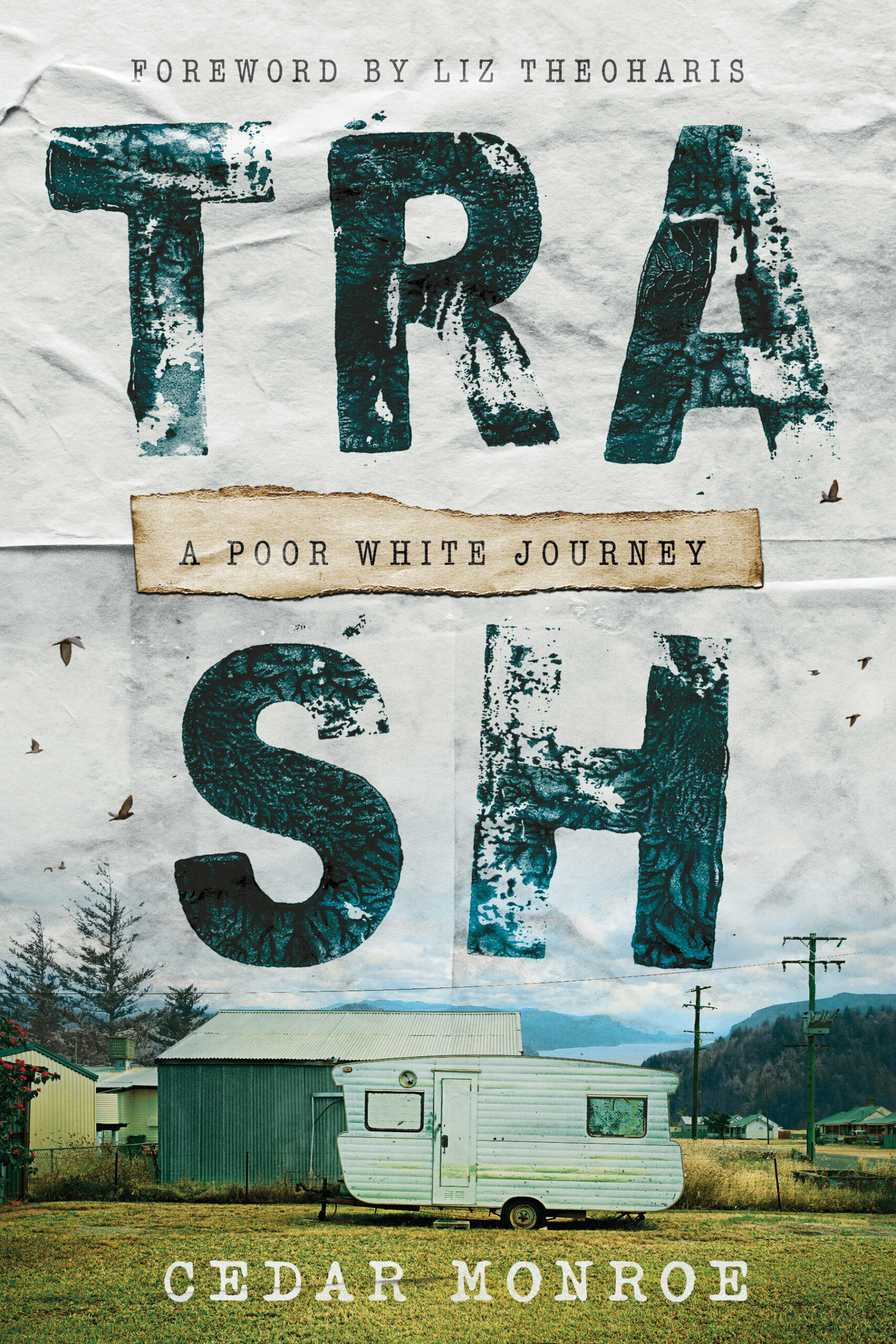
Review and Interview: Cedar Monroe, Trash: A Poor White Journey (Broadleaf Books, 2024, foreword by Liz Theoharis). Interview by Noam Sandweiss-Back and Tim Shenk.
Trash is part memoir, drawing on Monroe’s experiences growing up poor and white in the Pacific Northwest, part prophetic admonition of capitalism and colonialism, and part call to arms for poor white people to break with the empty promises of white supremacy and join an emerging multiracial movement of the poor for transformative social change.
In Trash, Monroe introduces readers to the uncomfortable realities of what it’s like to be poor and white in the 21st Century United States. Tragedy, rage, and levity live side by side in Monroe’s journey to organize poor and unhoused people in rural Grays Harbor County, Washington. Monroe adeptly and thoughtfully addresses the ideological forces of white supremacy and white Christian nationalism through a materialist lens. That is, Monroe digs beneath cultural and political explanations and puts the lived experience of American poverty into conversation with an economy that is failing millions of people across race. The book is a love letter to the 66 million poor white people in the United States to see how they have been wronged by a system that has used them as foot soldiers against other poor people. It is an invitation to poor whites to take up active participation in a social movement that demands dignity and abundance for all.
Noam Sandweiss-Back and Tim W. Shenk of the University of the Poor Journal sat down with Cedar Monroe to talk about the book and Monroe’s personal and political trajectory.
UPoor: Can you tell us what it was like growing up in Grays Harbor in rural Washington State? How would you describe your experience of religion, race and class?
Cedar Monroe: I think we struggle with defining class in the United States. So I sometimes struggle with defining my own class background. But I grew up in a very working-class family. I was born in San Jose, California. My dad worked for computer companies in Silicon Valley. He worked his way from a warehouse job to middle management, so there was a moment when my family was doing really well by working-class standards. But my dad couldn’t handle the pressures of the work, and then in the mid-90s the bubble burst and the industry took a big hit. My grandparents lived in Grays Harbor County, on the Pacific coast of Washington, so we moved there when I was 12.
Back in San Jose, my parents were part of a well-funded fundamentalist Christian homeschool movement that was centered in Silicon Valley. In the book, I write that my parents joined this movement because it offered them a sense of control in a world that was changing very rapidly. Christian fundamentalism offered them a narrative of the future that seemed to include them. When we left for Grays Harbor, we joined a wave of mostly working-class white families that were moving into rural communities in California and the Pacific Northwest to recreate the old ideal of the American homestead. These families started little groups and cults all over the place, and some also formed militias. My family never got involved in the more explicitly violent sides of this movement, but I still grew up super isolated.
By the time we arrived in Grays Harbor, the economy was in free fall. Back in the early-to-mid 20th Century, Grays Harbor was the top exporter of timber in the nation. Demand for wood was high during the world wars, and workers flocked in from all over the country, in the process leading significant union organizing drives. From what elders have told me, people’s lives were relatively stable in the post-war years, until the region started running out of trees and the demand for wood plummeted in the 1970s and ’80s. The region suffered significant deindustrialization and a decline in extraction-based industry, especially timber. After NAFTA in the early 1990s, the big timber companies started moving larger and larger shares of their business outside the country.
As a child, I remember watching individual loggers going from place to place, looking for small jobs on small properties. Most of my generation, especially the boys, were raised to believe that they would someday work in the timber industry. By the time they came of age, those jobs didn’t exist. Instead, there was a massive spike in unemployment and homelessness. And, as the formal economy collapsed, an underground drug economy emerged as a primary means of survival. At one point, Aberdeen, a small city in our county, was one of the largest consumers, and probably producers, of meth in the country, certainly on par with Midwestern towns like Lebanon, Missouri.
Back when the timber industry was still active, a lot of workers used meth as a way of managing extremely demanding and dangerous work. These are jobs that require long hours and really treacherous conditions. Logging is still the most dangerous industry in the country, with the highest fatality rate. People used meth to sustain their ability to work and to manage chronic pain and lifelong injuries. Many timber workers were also Vietnam veterans who returned home addicted to military-prescribed amphetamines. Once jobs started disappearing, the production of meth became the replacement economy.
Even before the 2007-2008 economic crash, people outside the region didn’t seem to understand why the younger generations were addicted and out of work. Much like in Appalachia, the blame was placed on poor communities. The old “culture of poverty” arguments reared their ugly head again. Outside of Grays Harbor, very few paid attention to the massive job loss and economic displacement that was wrecking our community. At the time, the fishing industry was also spiraling into massive decline. While the land was suffering from deforestation, the water was suffering from overfishing. Grays Harbor is still home to a lucrative port, though the revenue only flows to a few companies.
UPoor: It’s really helpful to ground this conversation in the economy as a counterbalance to these patronizing and individualized myths about why people are poor and out of work.
CM: Yeah. I mean, even the way we talk about the rise of white Christian nationalism in areas like Grays Harbor is untethered from a larger understanding of the conditions on the ground. I don’t think that the only reason is economic, but it is important to recognize that this movement was growing in the ’80s and ’90s, when many white working-class jobs were at risk. In the ’80s, there was a massive decline in working-class jobs, and the rise of tech. There is a direct correlation between the rise of white Christian nationalism and that sense of economic insecurity. Many people I knew growing up were turning to ideologies that enforced a narrative of stability, even if they were dangerous and toxic and undergirded by white supremacy. I think we make a mistake where we think that these ideologies are particularly driven by hate. They’re often driven by people’s economic conditions and by idealized versions of American history and their place within it.
UPoor: Like you say, many treatments of the rise of white Christian nationalism exist outside of a materialist analysis. Often, the explanations given are cultural or political alone, and don’t account for the fact that the rise of Christian nationalism in its modern form is happening amid this enormously disruptive economic transformation.
CM: The correlation is almost exact. You can trace a line between the destabilizing of white working-class jobs and the rise of tech and of conservative televangelists and all of that.
UPoor: By your early-to-mid-20s, many of your peers were incarcerated or had died from drug overdoses, housing insecurity, police abuse, and gun violence. Meanwhile, you share in the book that you found your way to community college, then to a liberal arts college in Washington, and ultimately to an episcopal seminary in Boston.
Before and during seminary, you also have very formative experiences traveling along the US-Mexico border and within Mexico, learning among working-class people steeped in liberative forms of Christianity. Can you tell us about these formative experiences?
CM: I kind of escaped the fate of my peers, mainly because I married someone who was also working-class, but whose grandparents invested well and were millionaires. That relationship pulled me out of poverty for a very short while. The marriage was kind of a nightmare, and I left it relatively quickly and couch surfed while I finished college. After college, I spent some time in Oaxaca, in southern Mexico, and then during seminary I spent time on the border. A lot of the people I met came from organized poor communities that were educating themselves about why there was mass migration from Mexico into the United States. They understood the material conditions that were worsening poverty and displacement in Mexico, including land loss and corporate takeovers after NAFTA. This was my first experience getting an on-the-ground materialist answer to conditions that shared at least some basic similarities with the conditions I had lived through and observed in the Pacific Northwest.
Parallel to that experience was my experience doing work on the streets in Boston during seminary. The unhoused folks I met were also self-organizing to survive, although they weren’t nearly as well educated on the root causes of their conditions as people I’d met in Latin America. But they were aware that something was deeply wrong with a society that was just throwing them away. During seminary I studied leftist politics and liberation theology, but mostly within an academic frame that was usually deeply disconnected from reality. Working among those communities – in Mexico and Boston – really formed and shaped me more than anything.
While I was in seminary, I lived in Cambridge, Massachusetts, where I experienced a tremendous amount of classism. There is a tendency in white liberalism to scapegoat poor white people as the problem, particularly when framing an anti-racism that is isolated from a material understanding of systems like colonialism and capitalism. In Cambridge, the seat of Harvard University, there is just this massive disparity of wealth. I watched people shopping on the most expensive streets in the world while mass numbers of poor people of every race were literally begging at their feet.
In our critique of white Christian nationalism, we also need to understand the failures of white liberalism. White liberalism is really, really invested in this kind of savior mentality towards people of color and poor communities. It’s not actually an ideology that sits and listens to communities of color any more than it listens to any poor communities. White liberals like to set themselves up as the good guys, and that’s a problem. It’s a kind of moral self righteousness that isn’t rooted in any actual material solutions to the problems faced by poor and dispossessed people.
UPoor: It’s striking to see the different choices you’re given as a poor white person. These false choices between rightwing extremism and liberal paternalism. You didn’t fall for either. In the book, you also write about white poverty and systemic racism in a way that avoids falling into the trap of a shallow version of identity politics, while still understanding the history of white supremacy and the work that poor white folks have to do to build bridges with poor people of color and Indigenous peoples. How do you navigate these various dynamics in organizing, in life, and in writing about it?
CM: Writing the book was an exercise in terror, because there’re so many ways to get it wrong, and I’m sure that there are ways I did get it wrong. But at least I tried to avoid the worst of these dynamics. One thing I have found helpful is developing a deeper understanding that racial tensions and ideological differences are rooted in larger systems and arcs of history, rather than simply hatred. When you can place poor people, including poor white people, within a materialist analysis, then you can move away from individual blame. You come to see the ways poor people across race have been pitted against each other, not just ideologically, but materially.
From my vantage point growing up in the Pacific Northwest, it’s been very instructive to understand the history of this land. After the Louisiana Purchase, the United States pushed poor white settlers into communities that had existed for millenia in order to create conflict, take over the land, so that the elites could develop it and make money off of it. So instead of simply saying that this was about individuals who did horrific things, I find it helpful to take a more systemic and materialist perspective on the ways poor white people were used as the foot soldiers of colonialism. Poor white people were settlers on stolen land and participated in genocide and were often paid to do so. But this wasn’t because individual poor white people people decided they wanted to do this. This was because of government policy within a larger process of capitalist production and expansion.
Within this frame, it’s not helpful to try to valorize white poverty. There are some serious moves towards that within white supremacist circles. It’s possible to acknowledge the position that poor white people have found themselves in – both the damage they have done and the harm that has been done to them – in a way that creates the conditions for deeper understanding and solidarity with other poor people.
UPoor: We wonder if something like the experience of Reconstruction after the Civil War offers an alternative example for poor white people. In this period, a noteworthy number of poor white farmers who were once an impediment to abolition now join formerly enslaved Black workers in building the Reconstruction governments. They begin to recognize that, amid the ashes of the old slaveholding order, there is a pathway for their own social and economic advancement. For eight years – before Reconstruction was brutally cut short – these fledgling, multiracial alliances built unprecedented political power for the poor, in the process passing some of the most progressive social and economic policies in American history.
CM: Du Bois is, of course, brilliant on that historical moment and that missed opportunity. One thing I would add to that, and I think I allude to this in the book, is that Reconstruction happens at the moment of Western expansion. So the safety valve for the guardians of empire is that they can push a lot of poor white people out of having to actually come to grips with and create solidarity with poor Black workers. Instead, they can send them out to the frontier, as both settlers and as a kind of vanguard army against Indigenous people. This use of poor whites in Western expansion was part of the racial antagonism that was necessary in order to maintain a system of colonial exploitation.
UPoor: Your vantage point having grown up at the farthest Western edge of the country, at literally the last possible place people could be pushed, situates you well to see these overlapping dynamics. One thing about the book that is really compelling, and even surprising, is how much treatment you give to the history of colonialism, genocide, and the dispossession of Indigenous peoples. This is such a key part of the story of poor white people in this country, but it’s rarely told in the way that you tell it.
CM: It’s something that I missed for a long time until I ended up in a position where I was working and organizing with Indigenous people on their own land, and developing relationships, in the larger sense, with Indigenous nations. Two things struck me when I was doing that. One, that I was standing on land that only 200 years ago was not capitalist. Because I’m so far west, the dispossession of Indigenous people didn’t happen until 1855. And the second thing is that 200 years ago, this area was a thriving Indigenous economy. There is all of this evidence of a completely different way of living, and many of these traditions are still being maintained today against the backdrop of global capitalism. There is still an Indigenous Potlatch where the whole point is to give everything away. Folks compete to see who can give the best gifts.
The Quinault Indian Nation, on land where Grays Harbor is now situated, was completely dispossessed by the federal government. They were forced to turn their reservation into private property, but starting in the ’60s, they began to force the government to buy that land back for them. Now they hold a lot of that old reservation land in common. They run a casino and other capitalist enterprises, but they own them collectively. All of the money they make belongs to the tribe, to every member of the tribe. So it’s either paid out as per diem, as dividends, or it is invested in the healthcare and education for the tribe, as a way to reverse the longstanding federal policy of neglecting Indigenous peoples.
The history of capitalism on the coast of the Pacific Northwest is really short, and there was something here before that worked really well for a really long time. Was it socialism? Does it resemble socialism today? I don’t know. I would say most people on the Quinault Nation’s council who I talk to are not particularly leftist. Many of them are quite conservative. But that doesn’t change the material reality where there’s this sense that the traditions of the tribe make it impossible to run businesses in any way other than what we might call a socialist or collectivist ethic.
There’s tension between poor white people out here and Indigenous people, who were dispossessed from their lands but were not removed like they were farther East. I had this conversation, and I think it shows up in the book, with a young white man who was a fisherman. He had worked on boats his whole life and was mostly paid in drugs, which kept him in perpetual homelessness and poverty. He was complaining about all of the things Native fishermen get that he didn’t – they get per diem or regular payouts from their tribe, and they have healthcare, which he didn’t have.
I finally said, “What would it mean to you if you lived in a world, in an economy, that actually took care of you? That actually thought that you deserved to be taken care of, where you had the same right as everyone else to benefit from the fruits of your labor?” There was this moment where he was like, “Oh, wow.” The moment didn’t last very long, but I do think there is a way to make an argument to poor white people that an economy more like that would benefit everyone.
UPoor: This is such a simple and yet such a profound point –that speaking to people’s material reality, and organizing around people’s shared material reality, can be a revolutionary orientation in these times. And a necessary orientation, because of where the economy is heading. Our organizing approach has to make an effort to win a swath of the 66 million poor white people in this country. Based on where you’ve lived and worked, you have had a particular window on what happens to communities – even majority white communities – when the base of the economy disappears, a dynamic that is coming for communities everywhere, if it’s not already here.
There is a lot we haven’t gotten to yet about your organizing work with Chaplains on the Harbor, and how you and others have been organizing around material needs and are in real relationship with people in and out of the homeless encampments. We want to encourage people to get their hands on the book, either by buying it yourself or encouraging your local library to get it. And we’d love to circle back to you, Cedar, and have another round of conversation with others who are in struggle and grappling with similar questions.
CM: I would love that.