
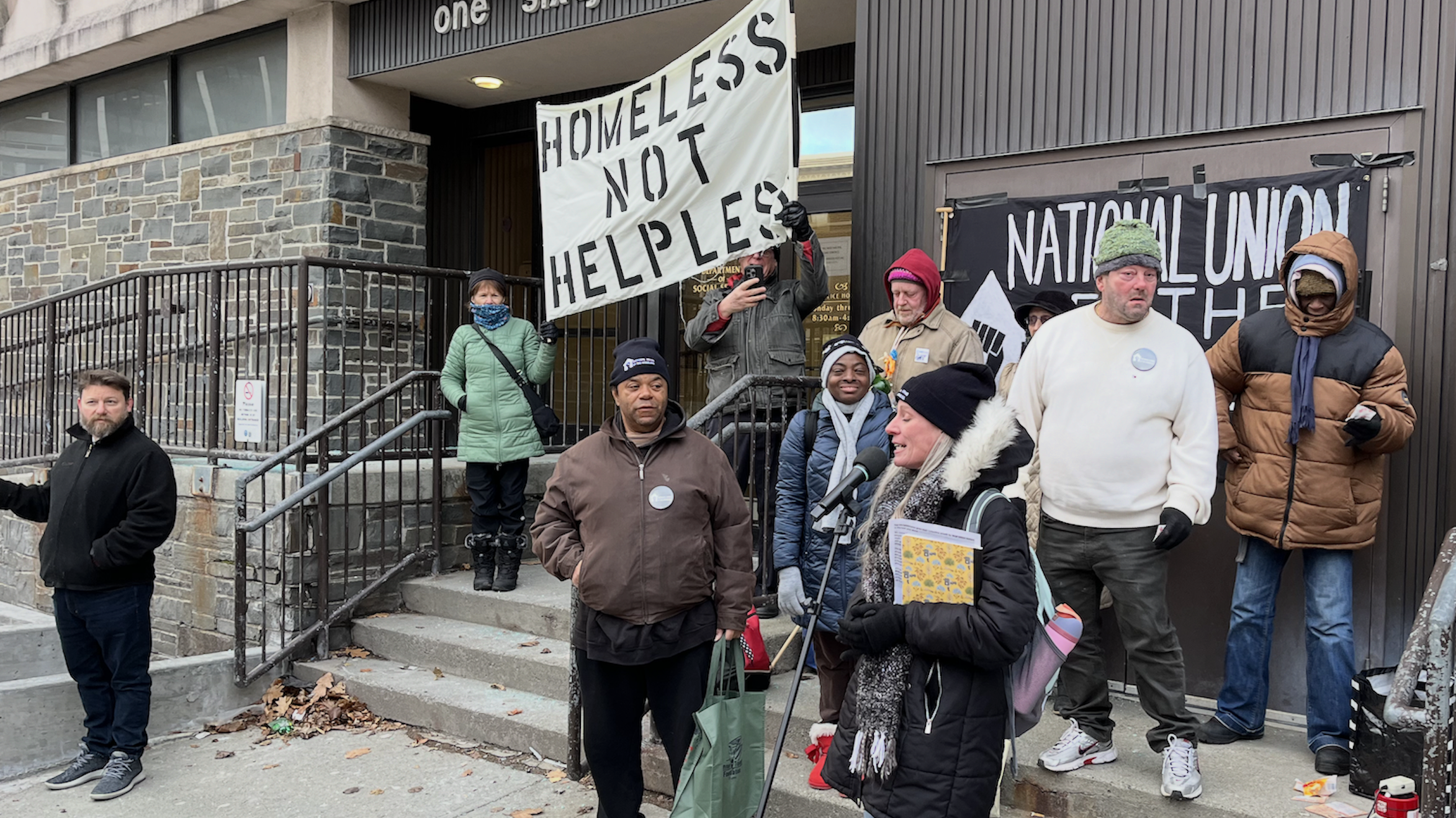
By Todd Cherkis
This article is in three parts and will be published over three University of the Poor journal editions. The main objective is to give a detailed accounting of the Supreme Court’s ruling in the Grants Pass case. The court ruled that fining and caging homeless people was not a violation of the 8th Amendment’s cruel and unusual punishment provision.
Part one goes through the decision, what the justices argue, their dramatic overreach, political party alignment, and the state’s efforts at disorganizing the poor through its defense of the homeless industrial complex.
Part two will provide a larger context of the growing homelessness and connect this back to the Grants Pass Decision.
Part three will go into the ruling class’s “model” for internment of the poor and how the National Union of the Homeless is organizing and responding to this new political/legal situation and growing perilous economic landscape.
The responses from the National Union of the Homeless illustrate how the organized poor are making a way where there seems to be no way.
Part 1
Georgia reached a new low in its war on the poor in 2023. The State Legislature passed a law giving the state Attorney General the power to sue city or county municipalities for failing to enforce bans on homeless encampments. The bill’s lead sponsor Senator Carden Summers, noting that homelessness had risen in the state by over 50%, offered: “The cities need to find a safe place for them to sleep, like in a parking lot, or a vacant area somewhere where they know they’re safe and have some dignity. With hopefully a porta-potty or porta-shower”1. The new law also restricted the movement of homeless people, mandating that when apprehended, the homeless must provide proof of their last known address so they could be returned to that county. Municipalities are now mandated to spend its resources enforcing camping bans, or risk losing HUD state funds and FEMA support for food and shelters2.
In April 2024, the Supreme Court gave Georgia the teeth it needed to enforce its new law with a 6-3 decision on Grants Pass v. Johnson, reversing the 2022 9th Circuit Court decision in favor of the homeless in Grants Pass, Oregon who argued that they shouldn’t be criminalized for being homeless, when Grants Pass had no shelters for them, and a similar 2018 case, Martin vs. Boise. Helen Cruz lived in an encampment in Grants Pass because she had nowhere else to go after she left work as a house cleaner: “We’re not out there because we want to be. We don’t have a choice. There’s no place to go”. In Grants Pass the ordinance called for the arrest of people found in encampments, in Boise, Idaho they were fined. In both cases the 9th Circuit Court sided with the homeless, and struck down the laws as “cruel and unusual punishment.”
Almost immediately, Grants Pass appealed. Both Republican and Democratic political leaders including California Governor Gavin Newsom contributed amicus briefs in support of criminalization. Pushing back, Ed Johnson of the Oregon Law Center which represents the homeless in the case explained that Grants Pass “did what’s not allowed, basically make it illegal for people to exist”3. The plaintiffs had argued successfully in the lower courts that these laws criminalized people for their status of being homeless. And under the precedent of Robinson vs. California, the 1962 decision in which the Supreme Court found that it was unconstitutional to criminalize someone for their status as a drug user, this would constitute a violation of the 8th amendment.
Nonetheless, the Supreme Court released their ruling on June 28, 2024 reversing the decision of the 9th Circuit Court, maintaining that the Grants Pass ordinance was not in violation of the 8th Amendment barring cruel and unusual punishment. The decision, which fell along ideological lines, was 6-3. Justice Gorsuch writing for the majority did not view the fines, barring of repeat violators from park space, and even jail time imposed as either cruel or unusual. After all, these penalties were typical to most jurisdictions when it came to homelessness and sleeping outdoors.
Somewhat inconceivably, the majority viewed the Grants Pass ordinance as targeting all people who chose to sleep in public parks including backpackers and student protesters (Gorsuch’s hypothetical examples). Justice Clarence Thomas in a concurring opinion went further arguing that Robinson vs. California should be done away with altogether as a precedent and that criminalizing people based on their status of being homeless was not enough to constitute cruel and unusual punishment.
Justice Sotomayor in writing for the minority, argued that in ruling against the homeless, the majority was lowering the baseline of protections for all. Cities were already permitted to criminalize many behaviors— from littering to loitering to public urination and defecation to disorderly conduct. But in their decision on Grants Pass v. Johnson, the majority had now included the criminalization of people’s sleep. Sotomayor’s opens with
“Sleep is a biological necessity, not a crime. For some people, sleeping outside is their only option. The City of Grants Pass jails and fines those people for sleeping anywhere in public at any time, including in their cars, if they use as little as a blanket to keep warm or a rolled-up shirt as a pillow. For people with no access to shelter, that punishes them for being homeless. That is unconscionable and unconstitutional. Punishing people for their status is “cruel and unusual” under the Eighth Amendment”.
She goes further in clarifying how low the bar is being set, summing up the majority ruling for the poor and dispossessed: “Either stay awake or be arrested.” She then argues that in addition, to follow the majority’s logic, their ruling means stay awake, be arrested, or leave our town:
Grants Pass’s Ordinances criminalize being homeless. The status of being homeless (lacking available shelter) is defined by the very behavior singled out for punishment (sleeping outside). The majority protests that the Ordinances “do not criminalize mere status.” Ante, at 21. Saying so does not make it so. Every shred of evidence points the other way. The Ordinances’ purpose, text, and enforcement confirm that they target status, not conduct. For someone with no available shelter, the only way to comply with the Ordinances is to leave Grants Pass altogether4.
Sotomayor in this way invokes a history extending back to 14th century English laws and practices that worked to control the movement of poor laborers. The bubonic plague “Black Death” caused a severe labor shortage. Workers were confined and punished for seeking better work in other towns5. This would later be adopted to confine sharecroppers under what was called “enticement laws”. These laws, like the English vagrancy laws, prevented sharecroppers from being “enticed” by other employers who offered better wages and conditions than their current circumstances6. Combining the concerns of industry in controlling labor, these early anti-vagrant policies conveyed the power to decide who was “in” and who was “outside” community life. “Warning-out laws” “empowered local colonial authorities to notify unneeded laborers, or other new people in town that they would have to leave”.
During the Great Depression, western states passed laws that criminalized people, derided as “Okies” and those who tried to offer aid and comfort. In 1941, The Supreme Court took up Edwards vs. California the case of a man criminalized for helping transport homeless migrants into Yuba County California. In a unanimous decision, the United States Supreme Court found that California was in violation of the constitution for attempting to ban homelessness from its borders. In its ruling, The Supreme Court found that California had run afoul of the Commerce Clause and the basic rights of “life, liberty, and the pursuit of happiness.” The Court determined that the state of California could not shield itself from the impacts of the Great Depression by simply pushing out the poor onto other states.
However, criminalizing people for their status was a nationwide issue, most notably in the Jim Crow South. By dividing labor and creating a reserve of workers paid far below other industrial regions of the United States, the South was able to control the economics and politics of the entire country. The legal disenfranchisement that Jim Crow institutionalized was enforced by multiple means. Sundown towns, often pursued by violent enforcement of the unwritten rule that all nonwhites leave by sundown were prevalent across the South, and existed as far afield as Minden Nevada and Antioch, California 7.
A town’s well-known status as a Sundown Towns threatened the physical safety of Black and immigrant labor8 and limited their economic and political power there.
As we move into a future in which technology increasingly replaces human labor, and the population of dispossessed laborers continues to grow we should not be surprised by the return and vehement efforts to expand on these laws and practices. The Supreme Court’s majority decision is significant in that it allows this lineage of social control and confinement of the poor to march forth through the present and into the future.
Justice Gorsuch, speaking for the majority, complains that the 9th Circuit Court’s ruling on Grants Pass turned on its definition of the “involuntary” homeless. How was a municipality supposed to know whether someone was voluntarily or involuntarily sleeping in the park?
However, he conveniently didn’t acknowledge the response the Boise administration had to Martin. 9th Circuit Court decided that if a jurisdiction did not have the shelter beds necessary to at least temporarily house people, they could not prosecute people for sleeping outdoors. So the Boise administration adjusted how it would address encampments. Police would simply call the three shelters in town to check on available space. Once those shelters were full, the police stopped citing people for camping9.
On the surface, Gorsuch’s conclusions are illogical: of course jurisdictions were targeting, and continue to target the homeless for sleeping in public spaces. And yes, there are not enough shelter beds or affordable housing options for people. These are common, seemingly innocuous facts. Gorsuch employs California Gov. Gavin Newsom and London Breed, the San Francisco Mayor among others to push these facts aside, explaining that Grants Pass and Martin were limiting the “tools” needed to address homelessness, and more directly getting the homeless to “accept city serivces” (San Fransisco Mayor amicus brief). Here we get closer to the problem, Gorsuch sounds the alarm: “Many cities further report that, rather than help alleviate the homelessness crisis, Martin injunctions have inadvertently contributed to it. The numbers of “[u]nsheltered homelessness,” they represent, have “increased dramatically in the Ninth Circuit since Martin.” He goes on to say that that these rulings in favor of the poor “weaken” the ability of public officials “to persuade persons experiencing homelessness to accept shelter beds10.”
In the decades leading up to the Grants Pass and Martin decisions, municipalities imposed bans on sitting or lying down. By 2024, the prevalence of these laws had gone up by 78% since 2006. Laws criminalizing sleeping in your car went up by 213% and camping bans up by 92%.
Rather than focusing on the causes of homelessness, jurisdictions chose to criminalize it. And the victory at the 9th Circuit Court in Martin was blamed for the rise in homelessness: “Indeed, many states and local jurisdictions within the Ninth Circuit reported a significant increase in unsheltered homelessness in the wake of Martin. For example, in Sacramento, the population of homeless individuals grew by 67 percent between 2019 and 2022., with over 70 percent (about sixty-five hundred people) sleeping outside in public spaces 11”.
Dissenting from the Ninth Circuit’s Martin ruling, Judge Collins predicted that upholding the 8th amendment to protect against criminalization, would have “dire practical consequences” for the city and others like it. What Collins and the Supreme Court were zeroing in on were the dire consequences of having to see the homeless, visible in the shanty towns and tent cities being erected. The real problem identified in the Majority’s reversal of the Ninth Circuit ruling(s) is that it acquiesces to the homeless’s resistance to the homeless industrial complex, Gorsuch writing for the Majority:
Doubtless, the Ninth Circuit’s intervention in Martin was well-intended. But since the trial court entered its injunction against Grants Pass, the city shelter reports that utilization of its resources has fallen by roughly 40 percent. See Brief for Grants Pass Gospel Rescue Mission as Amicus Cu- riae 4–5. Many other cities offer similar accounts about their experiences after Martin, telling us the decision has made it more difficult, not less, to help the homeless accept shelter off city streets.
This increase in unsheltered populations across the West should be seen as a resistance to the homeless industrial complex represented by the “shelter system”. The encampments grew because there were now some legal protections but also because people wanted autonomy and freedom that the shelter system takes away. Shelters typically restrict residents rights as tenants (often evicting people without due process); maintain no rights of privacy; practice systemic family separation (most shelters are for either men, women or women with children with very few beds for parents with children); make unpaid labor conditional for shelter residents; constitute health hazards including unmonitored drug use as well as the spread of viruses (COVID), spread of TB; and often pose the threat of theft and assault:
“The bottom line is, American cities have taught many people to distrust offers of services and shelter. Through experience, many people experiencing homelessness have learned these offers do not promote safety, stability, and dignity. They do not spare people from the endless trauma of homleessness. These lessons are so well-worn for chonically unsheltered people that even if a meaningful offer of service were eventually extended, many reasonable people have already learned to decline it 12”.
Municipalities who find their shelters with empty bed space should look towards those shelters to find out why instead of focusing on the “dire consequences” of homeless people self-organizing encampments and a flat out resistance to the shelter system.
This could have been an opportunity to point out the obvious – it’s the economy, stupid. Almost a year prior to the Supreme Court ruling, researchers at UC San Fransisco released the results of the most representative study of homelessness this century. It was a deep dive into the lives of homeless people in California, that included survey data from over 3,000 and interviews with over 300 homeless. Was this population of the visibly homeless, really “interstate migrants” looking to take advantage of a sudden shift in Western states’ posture towards criminalizing them? The study answered with a definitive – No, Of those surveyed 90% lost their home in California, and 75% in the county where they were currently homeless.
California has the largest homeless population with half of the unsheltered homeless living in the state. The economy continues to produce this crisis: “California is home for most of its homeless population. The most frequently reported reason for loss of housing was reduction of income due to unemployment or a decrease in work hours. Economic reasons were followed by two social ones: conflict among residents, and concerns about imposing on roommates or family members. These social reasons would, in a more affordable environment, lead simply to a change of address, not homelessness13.”
A July 2020 report on homelessness by the United States Government Accountability Office (GAO) stated that even when accounting for a multitude of variables, rising rents have made a statistically significant impact on homelessness, and that for every $100 increase in median rent there was an approximate 9% rise the rate of homelessness14.
1) Lewis, Alicia, “Ga. bill looks to ban people from sleeping on streets, SWGA leaders look to help homeless populations”, WALB News 10, April 23, 2023: https://www.walb.com/2023/04/18/ga-bill-looks-ban-people-sleeping-streets-swga-leaders-look-help-homeless-pop
2) Hudson, Scott, “Governor Kemp signs homeless bill into law”, The Augusta Press, May 14, 2023.
3) Ludden, Jennifer, “How far can cities go to clear homeless camps? The U.S. Supreme Court will decide”, National Public Radio, February 20, 2024.
Office of Governor Gavin Newsom, “Governor Newsom Statement on Amicus Brief Filed with the United States Supreme Court on Homeless Encampments”, March 04, 2024.
4) CITY OF GRANTS PASS, OREGON v. JOHNSON ET AL., ON BEHALF OF THEMSELVES AND ALL OTHERS SIMILARLY SITUATED CERTIORARI TO THE UNITED STATES COURT OF APPEALS FOR THE NINTH CIRCUIT No. 23–175. Argued April 22, 2024—Decided June 28, 2024
5) Ortiz, Javier; Dick, Matthew; and Rankin, Sara, “The Wrong Side of History: A Comparison of Modern and Historical Criminalization Laws” (2015). Homeless Rights Advocacy Project. 7. https://digitalcommons.law.seattleu.edu/hrap/7
6) Novak, Daniel A., “The Wheel of Servitude”, 1978, University Press of Kentucky.
7) https://en.wikipedia.org/wiki/Sundown_town
8) Ortiz, Javier; Dick, Matthew; and Rankin, Sara, “The Wrong Side of History: A Comparison of Modern and Historical Criminalization Laws” (2015). Homeless Rights Advocacy Project. 7. https://digitalcommons.law.seattleu.edu/hrap/7
9) Rankin, Sara, “Hiding Homelessness: The Transcarceration of Homelessness”, 109 California Law Review, 559, 2021.
10) CITY OF GRANTS PASS, OREGON v. JOHNSON ET AL., ON BEHALF OF THEMSELVES AND ALL OTHERS SIMILARLY SITUATED CERTIORARI TO THE UNITED STATES COURT OF APPEALS FOR THE NINTH CIRCUIT No. 23–175. Argued April 22, 2024—Decided June 28, 2024
11) Versteeg, Mila, Cope, L. Kevin & Mukherjee, Gaurav, “The New Homelessness”, California Law Review, Volume 113, April 2025.
12) Rankin, Sara, “Hiding Homelessness: The Transcarceration of Homelessness”, 109 California Law Review, 559, 2021.
13) Demsas, Jerusalem, “The Root Cause of the Homelessness Crisis”, The Atlantic, July 18, 2023. The full study “Toward a New Understanding The California Statewide Study of People Experiencing Homelessness” can be found here: https://homelessness.ucsf.edu/our-impact/studies/california-statewide-study-people-experiencing-homelessness. Thes study rebutted claims by politicians and prominent opinion setters including the Ayn Rand Institute’s Ben Bayer and author Michael Shellenberger (“San Francisco: Why Progressives Ruin Cities”). Shellenberger ran unsuccessfully for California Governor in 2022. A central tenent of his pitch to voters was that California had gone too “woke” and “soft-hearted” and that he would restore order — a hyper tollish version of Broken Windows. He proposed creating an agency dubbed “Cal-Psych” that would empower the government to force the unsheltered homeless into the shelter system and “treatment”: “And people who don’t want to enter his benevolent Cal-Psych program? They can go straight to jail” (see Siegel, Zachary, “Michael Shellenberger’s narrative of California homelessness is seductive. It’s also dangerous”, San Francisco Chronicle, May 15, 2022. A version of this forced institutionalization is currently being planned under President Trump’s executive order.
14) United States Government Accountability Office, “Homelessness Better HUD Oversight of Data Collection Could Improve Estimates of Homeless Population”, July 2020, GAO-20-433.
—
For over 30 years, Todd Cherkis has organized to build a poor people’s movement to end poverty. He began in the mid-1990s with the National Union of the Homeless in Atlanta, organizing alongside homeless day laborers building Olympic venues as they resisted the criminalization, displacement, and public housing demolitions tied to the 1996 Olympics. This was a period when tens of thousands were displaced and thousands arrested to remake the city for global audiences. From there, he continued organizing in Washington, DC with public housing tenants facing similar HOPE VI demolitions, and for more than two decades in Maryland with United Workers—bringing together day laborers, tenants, and low-income communities to fight for our basic economic human rights to work with dignity, housing and health.