By Avery Book, Kate Kanelstein, and Keith Brunner
Last year, the Vermont Workers’ Center celebrated its 25th anniversary, providing an opportunity to reflect on the lifecycle of this organization that we and many others have dedicated ourselves to building. Amidst a deepening political and economic crisis in the United States, it is extremely important for today’s revolutionaries to study and master history, including our own experience in the struggle, if we are to outmaneuver the ruling class and chart a path towards social transformation.
We believe our experience can offer insights into the indispensable role of organization and leadership in the class struggle, the need for clarity on who the enemy is and how they are maneuvering, and the importance of understanding the political and economic terrain that we are operating on. The story of how the VWC came to join and build the Nonviolent Medicaid Army can also shed light on the shifting center of gravity in the class struggle, as more and more of us are cast into direct survival struggles against the state for our basic needs and rights.
Early Roots: Organizing in the Era of Automation
The Vermont Workers’ Center was founded in 1998 by trade unionists, single moms on welfare, and low-wage workers with a mission to organize the working class of the state. Politicized by welfare reform and the North American Free Trade Agreement (NAFTA), the VWC’s founders opened an office in Barre, a small city in central Vermont. Home to world-class granite quarries and a workforce that was at one point 90 percent unionized, Barre’s jobs in granite and associated industries were hit hard by offshoring and automation, leading the city to become one of the poorest in the state. Amidst this backdrop of deindustrialization, Vermont’s growing healthcare sector, which generated low-wage jobs caring for an aging population, became a natural focus for the organization.
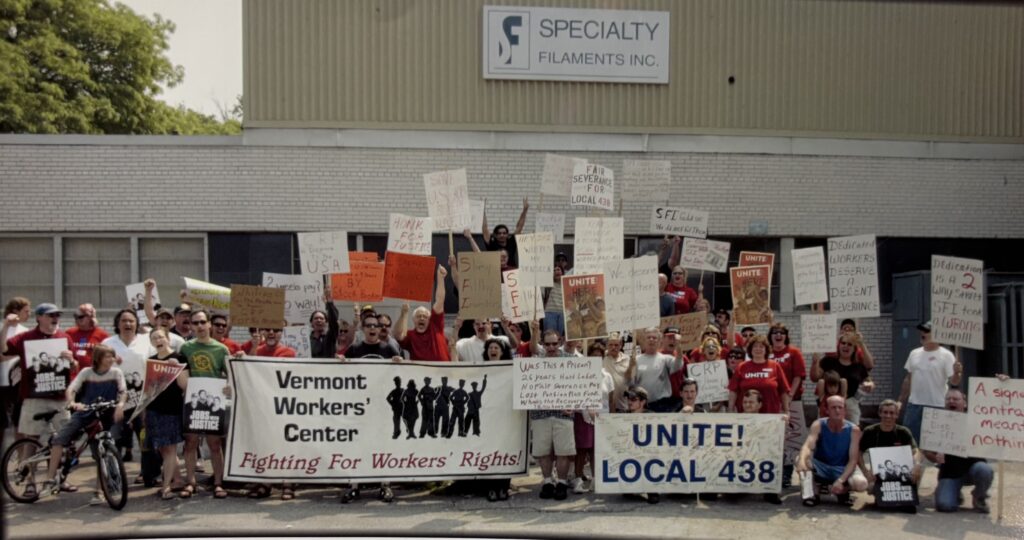
The early VWC joined the Jobs with Justice network and developed a reputation for labor solidarity, supporting organizing drives at Berlin Health & Rehab and Fletcher Allen hospital (today’s UVM Medical Center) while running a Workers’ Rights Hotline that scouted for union organizing leads. In the mid-2000’s, the organization co-led an organizing drive of food service and retail workers with the United Electrical, Radio and Machine Workers of America (UE) in the capital of Montpelier and supported a series of labor campaigns in Burlington, Vermont’s largest city. The VWC also played a leading role in mobilizing against free trade agreements and the Iraq war, linking these issues to local organizing through its participation in US Labor Against the War and Grassroots Global Justice Alliance.
Over time, healthcare emerged as our strategic focus. The loss of the Montpelier downtown union had demonstrated that while many low-wage workers were eager to organize in a new way, picking fights with small businesses missed the mark. Healthcare, by contrast, offered the opportunity to expand statewide and unite the working class across lines of division by going on offense in a political fight with a common enemy and a common target in state policy-makers. With a small staff, and inspired by UE Local 150’s efforts in North Carolina to build statewide around an economic human rights agenda, in 2008 the Vermont Workers’ Center committed to the fight for healthcare for all.
Making the Healthcare Crisis a Political Crisis
In her speech announcing the launch of the Healthcare Is a Human Right Campaign at the VWC’s 10th anniversary, Erika Simard shared that she had worked at a toothbrush bristle manufacturing plant since age 18, had a heart attack at 36, and then as president of her union, had fought for severance pay when a private equity firm bought and closed the plant. Now her unemployment put her just over the Medicaid income limit, leaving her struggling to afford the medications for her heart condition. “No one should have to go through what I went through,” she said, declaring the campaign’s aim to “make the healthcare crisis a crisis for politicians by mobilizing thousands of Vermonters to join us.”
Drawing on a core of committed member organizers and launched amidst the Great Recession, the HCHR Campaign quickly developed momentum: the healthcare crisis was a major and growing issue for the working class, and they found in the VWC a political home and vehicle to fight for their collective human rights. Grace Beninson, a leader who lost her home following a stroke that was the result of the denial of care, later reflected that “You don’t join the Vermont Workers’ Center — the Vermont Workers’ Center joins you.”
Over that first year, hundreds of people came out to Human Rights hearings that the campaign held across the state, testifying about their experience to put the healthcare system “on trial.” It was many people’s first time speaking out publicly, and those who spoke came from all political persuasions, identifying as Democrats, Republicans, or people who didn’t vote at all — a real motion in the direction of independent political power. The federal government’s bailout of Wall Street in the fall of 2008 added fuel to the fire of the campaign, sharpening many people’s consciousness of economic inequality and its connection to healthcare profiteering.
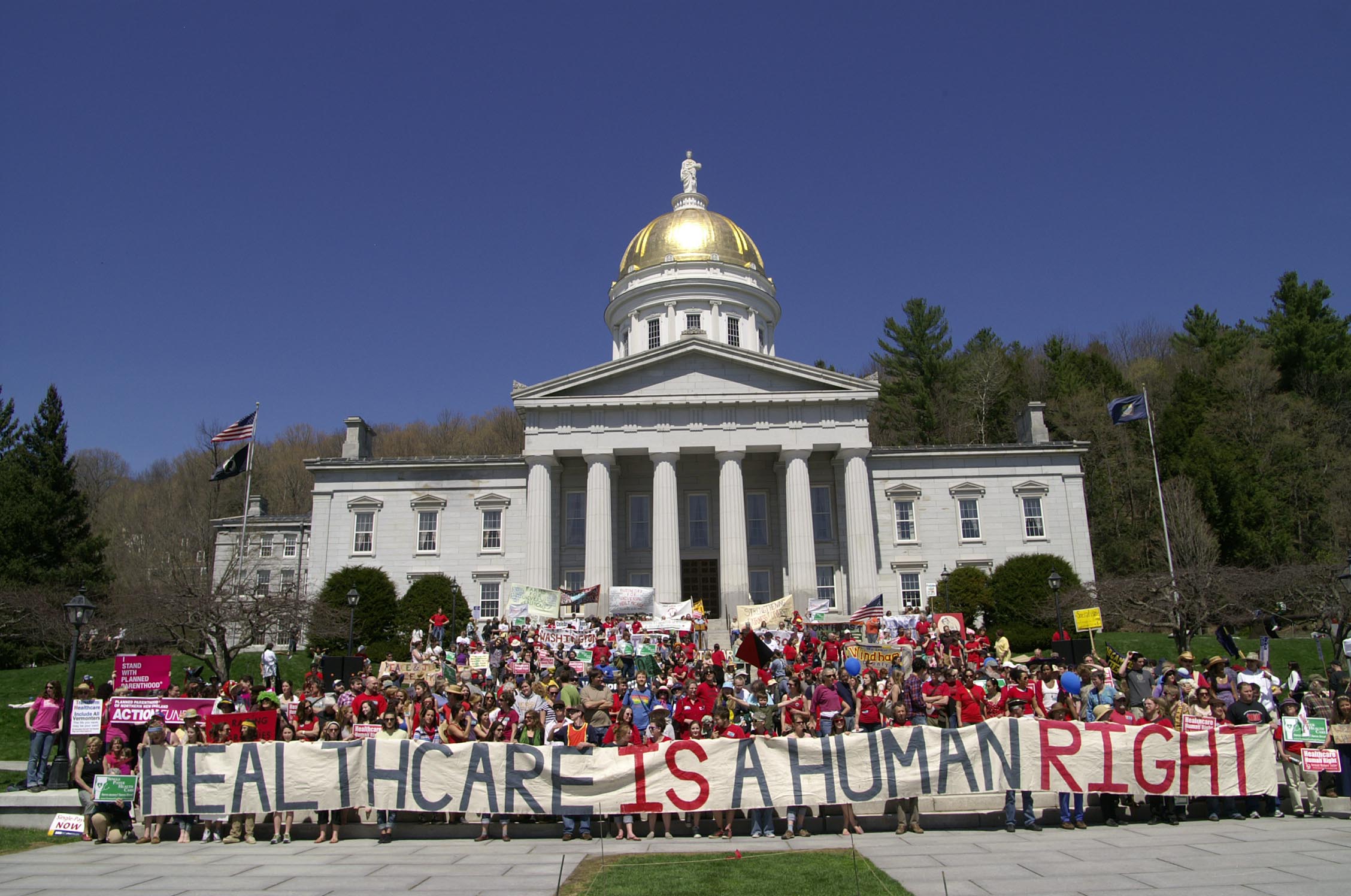
Through the Human Rights hearings, tabling, and door knocking, the HCHR Campaign built regional organizing committees across the state and surveyed 1,200 people, releasing a report on “Voices of the Vermont Healthcare Crisis” at a 500-person event in Burlington. That fall we held a series of trainings on the role of race and racism in US history, inoculating emerging leaders to the inevitable divide-and-conquer tactics that the powers-that-be would (and did) use to try to derail our movement. With this momentum, we held a rally at the Vermont State House on May 1st, 2009 that drew over a thousand people, with significant contingents from the Vermont Federation of Nurses & Health Professionals and other union members.
Central to the success of this initial organizing drive was our unity of purpose, as we applied the discipline of union organizing to political organizing in the community. The human rights framework, developed in partnership with the National Economic and Social Rights Initiative (NESRI, now Partners for Dignity and Rights), translated values into principles to guide policy and helped contribute to the campaign’s independence from any particular bill, party, or politician. The Vermont Workers’ Center became a center of gravity in the state for working-class Vermonters.
The Vermont Breakthrough
In the summer of 2009, as a national battle raged over the Affordable Care Act, Senator Bernie Sanders invited us to speak and table at healthcare town hall meetings that saw thousands turn out across dozens of small Vermont towns, with VWC members organizing people at the doors. While continuing to build our base around the state, we began preparing our leaders to take the fight to the State House. Six hundred people attended legislative forums the campaign held across the state, and hundreds more testified at hearings in the 2010 legislative session, resulting in the passage of a bill to study universal healthcare.
The momentum around the Healthcare Is a Human Right Campaign drew support from working-class Vermonters across political affiliation and in every county in the state, and pushed the gubernatorial candidates in the Democratic primary to compete over who was the biggest supporter of universal healthcare. This resulted in the November election of Peter Shumlin, who pledged to make it the primary goal of his administration. We forced onto the table an issue of great concern to the majority of Vermonters, an issue that both parties had preferred to ignore. Instead, our mass organizing made it one of, if not the most significant pivot around which the election turned.
Throughout this period, we continued base building and developing our internal structures, establishing a Policy Committee and “People’s Team” led by VWC president Peg Franzen to track developments within the State House in Montpelier and be ready to mobilize on a moment’s notice. The People’s Team brought a working-class vigilance to those halls of power historically run by corporate lobbyists and old-boy networks. Working with the Philadelphia-based Media Mobilizing Project, we built up a People’s Media Project committee that not only documented the campaign but fostered an awareness of the need to tell our own story amidst a mainstream media operating in the interests of the ruling class.
Our political education committee began expanding its approach from skill-building focused on tactics to developing strategists grounded in history and political economy, drawing on our relationship with the Poverty Initiative out of Union Theological Seminary and their charge to “Teach as we fight, learn as we lead, and talk as we walk.” Taken together, this internal activity created paths for emerging leaders to contribute to the development of the campaign and to their own development as leaders through the process. Many of these leaders began to make a deeper commitment not just to the HCHR campaign or even the VWC, but to a broad movement to end poverty led by the organized poor.
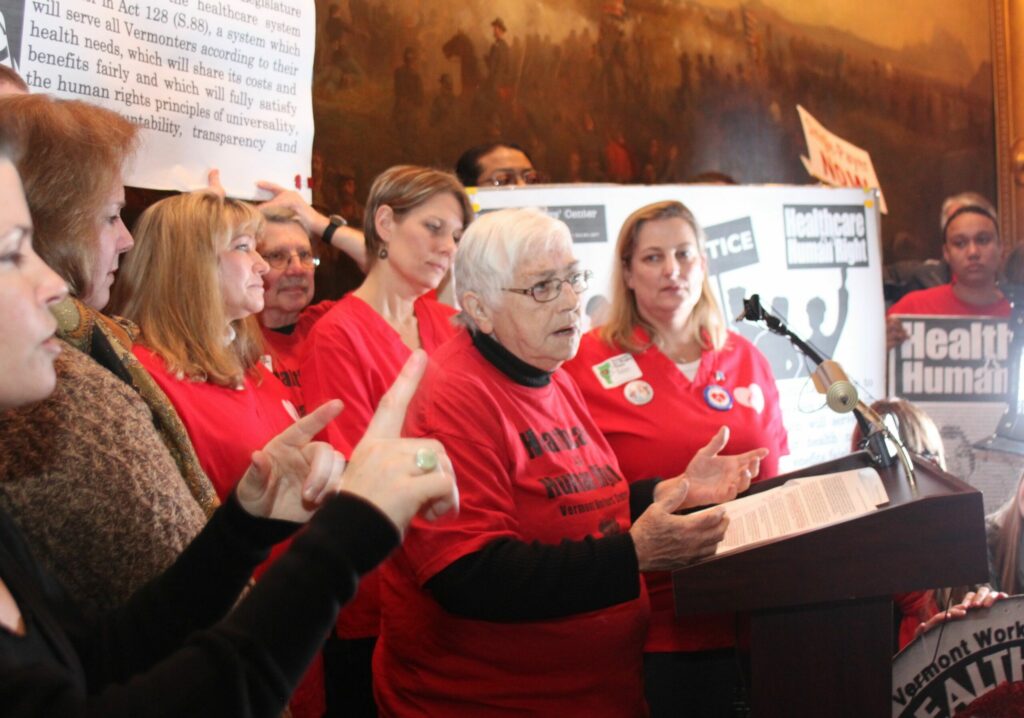
We kicked off the 2011 legislative session with a rally that brought hundreds of people into the State House, wearing red shirts and wielding stacks of petitions, in a disruptive show of support of a new universal healthcare bill. There was little precedent for this kind of working-class mobilization in the state or statehouse, and we were making the healthcare crisis a crisis for political leaders, who felt compelled to move the bill forward. When Democratic and Republican legislative leaders attempted to exclude undocumented people from the bill, we mobilized with farmworker leaders of the Vermont Migrant Farmworker Solidarity Project (what would become Migrant Justice) to defeat it, drawing on human rights principles and the earlier inoculation about racist divide-and-conquer tactics of the powers-that-be. With fanfare, Act 48 was signed into law, tasking Governor Shumlin with developing a financing plan.
It was a huge victory — and yet even at that moment, there were attempts in both mainstream and progressive news outlets to write the VWC out of the story, in particular our leadership of the working-class movement that laid the basis for and won this victory. That summer, we held debriefs across the state, resulting in an article on lessons from the campaign and the need to “cultivate a group of committed leaders and organizers who are as united and sophisticated as our opponents,” foreshadowing resistance to the state’s “dangerous example of providing healthcare as a public good.”
Through the fight for healthcare, we had built the Vermont Workers’ Center into a statewide organization. In the years following Act 48, we were able to wield that organization to provide leadership to events and other social forces coming into motion. We launched a Put People First! campaign focused on the state budget, anticipating that healthcare funding would be pit against other basic needs. This was borne out when Tropical Storm Irene produced severe flooding and policy-makers cited storm cleanup costs to justify cuts to public programs. VWC members threw ourselves into recovery efforts and supported residents of devastated mobile home communities in their fight to get the state to cover the cost of the cleanup, documented in the film “Strength of the Storm.”
When the Occupy Wall Street movement took off, we helped coordinate rallies in a number of towns outside of Burlington, providing a vehicle for newly politicized people to plug into long-term organizing. As the 2012 legislative session approached, we joined with Migrant Justice, organized labor, disability rights, and climate justice groups to form a Vermont Human Rights Council, passing legislation that added human rights language to the laws around the state budget. That summer, the Human Rights Council held a convention in Burlington with 500 participants, including delegations from what would become the Kairos Center for Religions, Rights & Social Justice and Put People First! Pennsylvania, that produced a human rights declaration and political platform.
It was four years since the launch of the Healthcare Is a Human Right Campaign, and the Vermont Workers’ Center was still riding a wave of momentum and attracting working-class Vermonters from every walk of life. We had established a statewide steering committee to consolidate new leaders from across the state, along with teams that advanced the different ingredients of the work, what came to be called the “People’s Recipe.” We went on national speaking tours spreading the good word about our approach and victory, attracting leaders from other organizations of the poor. Alongside Put People First! PA and NESRI, we joined with the Southern Maine Workers’ Center and United Workers out of Maryland to form the Healthcare Is a Human Right Collaborative, a network of organizations waging state-based campaigns for universal healthcare.
Know Your Enemy
Our universal healthcare victory in Vermont, won by an organized working-class movement, put us on the map nationally — and while we were on the right track with building a broader alignment of forces and taking on the state budget, we weren’t prepared for the sustained counter-offensive that came our way from Wall Street and a unified Vermont-based political and economic establishment. Governor Shumlin came under increasing pressure to abandon universal healthcare, and responded by delaying the release of a financing plan while cynically cutting Vermont’s welfare program. While parents on welfare among our base mobilized to reject these cuts, the organization’s lack of experience with community care made it difficult to support and hold on to these leaders. In the 2014 election, unprecedented amounts of dark money in the form of ads and mailings helped to unseat universal healthcare champions in the legislature, and contributed to a near-defeat for Shumlin in his reelection bid against a total political newcomer.
At the same time, national networks translating big foundation funding into ground-game operations for the Democratic Party set their sights on the Vermont Workers’ Center, mentoring a number of our leaders in the direction of pragmatic issue campaigning and candidate recruitment. With this influence, we grew from four to 12 staff, taking on big foundation grants that demobilized our membership base and sidelined our leaders, who became advisors to the staff. Our decision to take on a campaign for Paid Sick Days absorbed the organization’s attention, sending staff into obscure legislative districts scouring for particular testimony and contributing to our inability to sustain the emergent welfare rights work. This narrowing of our demands to reforms benefiting ever-smaller sections of the population undermined our ability to serve as an organic political vehicle for a working class in motion. A further blow came the night of the 2013 Membership Assembly, when we lost our president Peg Franzen to cancer — a beloved leader and mentor with incredible political clarity who held together the VWC’s many personalities and political inclinations.
In December 2014, Governor Shumlin announced that he was pulling his support for universal healthcare, claiming that it was economically infeasible — a message that was amplified in every major media outlet and remains the dominant narrative about Vermont’s universal healthcare attempt today. Yet Shumlin’s own financing plan contradicted this claim: 93 percent of Vermont residents would save money under universal healthcare while having access to comprehensive healthcare. We responded to the surprise announcement with mobilizations aiming to galvanize the legislature to take the lead on healthcare, including a rally with hundreds lining the halls singing inside the State House, and then with 29 people arrested as the Governor addressed the legislature. Working with NESRI, we released our own equitable financing plan based off of the state’s findings, which was introduced as a bill. Internal disagreements, however, resulted in a number of tactical blunders that undercut our efforts. When it became clear that Vermont’s political establishment was united against taxing the rich to pay for healthcare, we were unable to maneuver, with leaders taking away different lessons about where to go next. Demoralized members, already stretched by funder-driven issue campaigns, left the organization, and in 2015 the VWC’s director left to start a new project.
Getting Into Step
To forge a direction forward, and with competing impulses among our leadership, the VWC’s political education team conducted a study of Vermont’s political economy, leading to a course for our broader membership, while the campaign team facilitated a five-month reflection on the HCHR Campaign’s first eight years. By the summer of 2016, the grant-funded bubble burst and we ran out of money as an organization, laying off all of our staff. Faced with this moment of decision, our Coordinating Committee chose to recommit to the Healthcare Is a Human Right Campaign, concluding that the healthcare crisis objectively united a leading social force and was only going to deepen in the years to come. We began rebuilding the organization with a model that preserved our political independence by prioritizing leadership development and by not relying on foundation-funded staff.
It was clear from our experience that we were up against much more powerful forces than local conservative politicians, a point driven home for our leaders who attended schools hosted by the Landless Workers’ Movement (MST) in Brazil during this period. We needed a political strategy that anchored our campaign in US history, that flowed from an analysis of economic conditions, and that placed us in a position of strength against the forces of global capital. Drawing on our political economy studies and relationship with the University of the Poor network, we committed to uniting the 140 million people in the United States who are poor or one emergency away from economic ruin into, as movement mentor Willie Baptist puts it, a “force capable of awakening the middle strata of people and giving direction to the building of a broad social movement to abolish poverty forever.” While our earlier organizing had brought us into contact with the poor and dispossessed section of the working class, we hadn’t been able to facilitate or fully appreciate the leadership of those pushed out or pushed to the side by the digital technology revolution transforming the economy.
The launch of the Poor People’s Campaign: A National Call for Moral Revival in 2018, alongside Put People First! PA’s launch of the Nonviolent Medicaid Army in Pennsylvania, helped us to understand and build a stronger relationship to a base of poor people, employed and unemployed. VWC members played important roles in the initial 40 days of action of the Poor People’s Campaign in Vermont, which we followed with a 200-person March for Medicaid in St. Johnsbury that summer, using the march as a means to organize in the region. In the years that followed, we repeated the March for Medicaid organizing drive tactic in other “rust belt” towns of Barre and Bellows Falls. Political education and the systematic work of building up a core of leaders had made these new organizing drives possible.
Joining the Nonviolent Medicaid Army of the Poor
When the pandemic struck in 2020, we adapted by taking up hybrid online / offline tactics, demanding an emergency expansion of Medicaid while using the moment to link up with other leaders across the country committed to the unity of the poor.
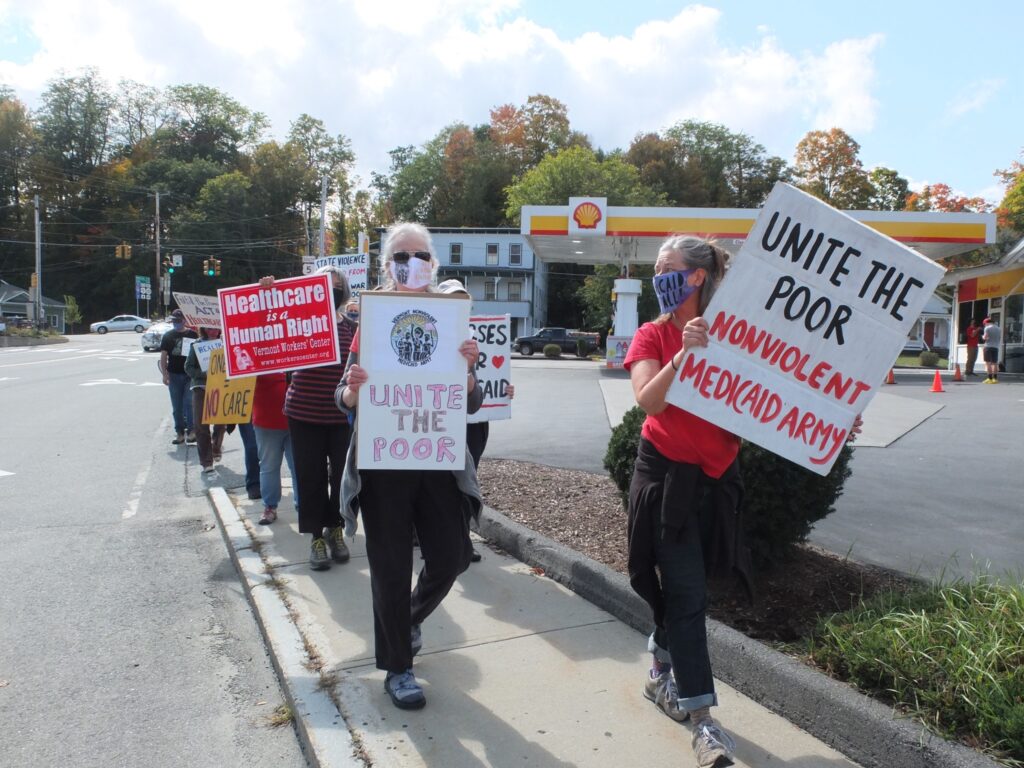
We joined the Nonviolent Medicaid Army when Put People First! PA expanded it from a statewide formation into a national network, modeled after Dr. King’s “nonviolent army of the poor” from the Poor People’s Campaign of 1968 and uniting those on or unfairly excluded from Medicaid as the leading social force. That fall, we held a leadership institute named for Peg Franzen, with 20 leaders studying lessons drawn from our organization’s history and establishing a new statewide Steering Committee to coordinate and lead the organization politically.
Since then, we’ve been deeply involved with building the Nonviolent Medicaid Army into what is now a national network spanning 12 states, cohered through an annual rhythm of studies and trainings, organizing exchanges, and a national week of action. Following the Biden administration’s decision to gut Medicaid protections and other life-saving programs expanded during the pandemic, we participated in the NVMA Medicaid Cutoffs Organizing Drive, base building across the state and holding actions under the slogan Medicaid Cutoffs = Policy Murder. In 2024, three VWC leaders joined the Nonviolent Medicaid Army Brigade to Cuba, studying the island’s free public healthcare system and social guarantee of housing, food, and other determinants of health built in the wake of the revolution, and in the face of incomprehensible obstacles imposed by the U.S. blockade.
The Struggle Is a School
Now in our 26th year, we believe the history of the Vermont Workers’ Center can offer today’s revolutionaries important lessons for our task of achieving a fundamental transformation of society. The VWC was founded as a labor solidarity network, providing vital infrastructure for the labor movement’s expansion into new sectors of the Vermont economy. Yet the limitations of this model led the organization’s leaders to move in a new direction — building out as a statewide membership organization wielding an economic human rights agenda, creating a political crisis around the denial of healthcare that led to a breakthrough policy victory. But this victory itself led to a new set of contradictions, which were resolved by securing the organization’s political independence through political education and committing to the unity and organization of the poor — the most revolutionary section of the working class — as the leading social force for change. In this most recent phase, the VWC’s leaders were nurtured by their leadership and activity in the Nonviolent Medicaid Army and the Poor People’s Campaign: A National Call for Moral Revival.
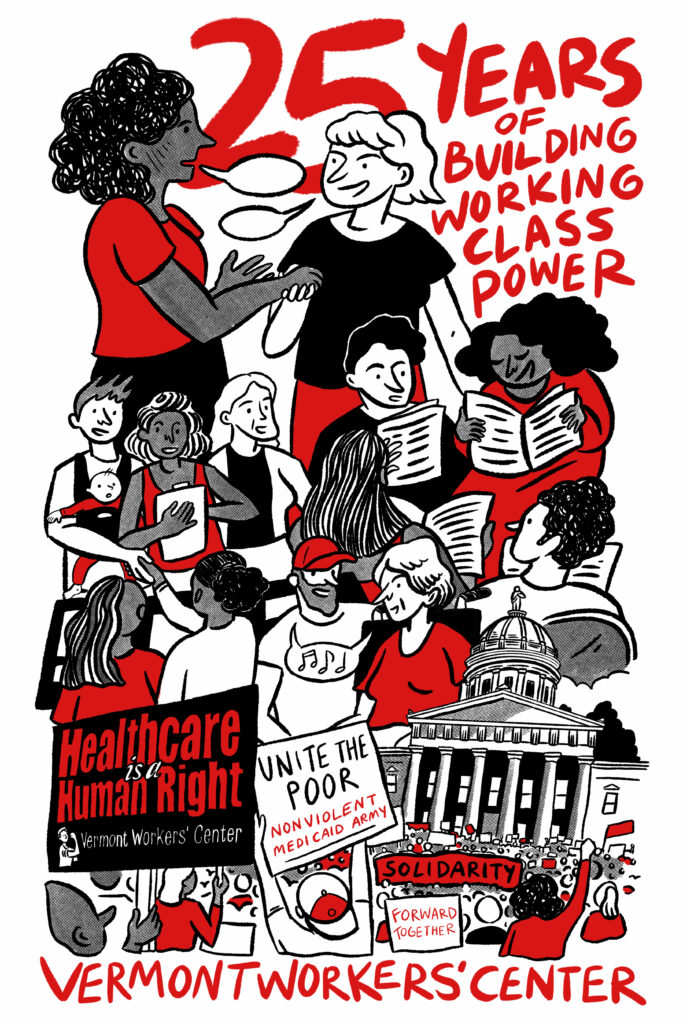
Five lessons stand out from the Vermont Workers’ Center’s history as an organization.
The first lesson from our experience is that political economy is central to political strategy: we can’t advance if our leaders are working on the basis of strategy developed for the conditions of the 1930s or the 1960s.
Since its founding in 1998, VWC members were active participants in fighting the layoffs and plant closures that turned cities like Springfield and St. Johnsbury into rust belt towns beset by poverty. In shifting to organize around people’s basic need for healthcare, we tapped into an issue that was broadly and deeply felt by the poor and dispossessed. The digital technology revolution that contributed to those plant closures is throwing a growing section of our class into a direct struggle against the state for the right to live and survive. The poor of today, as the Nonviolent Medicaid Army puts it, “are impacted by every single front of struggle there is – be it the fight for housing, a healthy environment, living wages, food, education, freedom from debt, freedom of migration, or freedom from criminalization and incarceration.”
In building a base amongst the poor, the Vermont Workers’ Center had to develop new methods and tactics of community care and Projects of Survival that temporarily met people’s needs while serving as an organizing on-ramp, such as the People’s Kitchen (now an independent project that partners with the VWC) and People’s Health Clinics. The VWC wasn’t alone in adopting these tactics — alongside other NVMA formations, the organization was consciously and collectively studying historical and contemporary movements of the poor organizing the poor, from the Black Panthers and Young Lords of the 1960s and ‘70s, to the National Union of the Homeless of the 1980s and today.
The second lesson is the strategic role of healthcare as a key front of struggle. As Put People First! PA and NVMA leader Nijmie Zakkiyyah Dzurinko points out,
“The ruling class has a fundamentally different interest in the healthcare system than the working class. For them, it is a recession-proof place to put their excess capital. For us, it is a matter of life and death in the struggle to secure our basic needs.”
The denial of healthcare, felt by millions of people, objectively unites our class — and in Vermont, we were able to use the fight for healthcare to build power statewide and unity across lines of division, and then wield that power to win battles on other fronts of struggle. While a strength for our class, healthcare is a vulnerability for the ruling class, which has no political solutions to this moral outrage. The capitalist class extracts enormous profit out of the system through cannibalizing public sector healthcare like Medicare, Medicaid, and the Veterans Administration, yet also depends on healthcare as a shock absorber and tool for social control. Lastly, there is a growing and exploitable split between capitalists that directly profit from our sick healthcare system and those that see growing healthcare costs eat into their profit margins.
A third related lesson is the importance of going on offense with a revolutionary demand. By articulating our demand using a human rights vision and principles, we avoided getting tied to any particular piece of legislation or politician. It meant we weren’t constantly on the defensive, fighting on the terms of the ruling class. But it was more than that — people saw in our platform the solution to their problem, and were willing to commit themselves to a campaign that was a bold step towards political independence. By demanding something the system cannot provide without fundamental transformation, this revolutionary platform, and the movement behind it, broke with the two parties and the sections of capital they represent.
The fourth lesson is the indispensable role of leadership, and of a united core of leaders. From 2008 – 2012, the Vermont Workers’ Center helped to spark and give expression to a mass working-class movement that drew in people of all political affiliations and from every part of the state. We were able to do this because our leaders were united around a program and series of tactics, moving in the same direction, which also helped guide us in coalition work and make use of political races to our advantage. Yet that unity around program and tactics was insufficient when the inevitable counteroffensive began to roll out — and arguably, other forces saw more clearly than we did the significance and threat of an organized working class winning major policy victories amidst an economic recession. We needed a deeper political and strategic unity — one rooted in history and political economy, and that pointed in the direction of fundamental social change.
The final lesson is clarity on who the enemy is. Today we face a split capitalist class, tied to different sections of capital and methods of rule, yet united in their attacks on and cruel manipulation of the poor to further their interests. We need to perceive how both factions of the capitalist class—the rising “right-wing populist” faction and the Council on Foreign Relations-led faction which has effectively run the US state through both parties since World War II—are competing for support from sections of our class in their battle for political power.
In taking up the HCHR Campaign, the VWC moved away from a syndicalist approach that viewed the work as an endless series of fights with individual bosses, hospital executives, or other local faces of capitalism. Instead, the campaign targeted Wall Street’s role in healthcare and its political power. The early years of the HCHR Campaign took place amidst a deepening polarization within the capitalist class, as the Democratic Party instrumentalized people’s healthcare grievances to pass the Affordable Care Act in the face of opposition from the right wing populist Tea Party movement and its big-money backers.
Following the Act 48 victory, both factions of the capitalist class turned their networks in our direction. It was obvious to us when dark money mailers warning of “big government” scared Vermont voters off from reelecting supporters of universal healthcare. What was less obvious was the role and intent of the national networks and offers of big foundation funding that came our way, which had the effect of co-opting our leaders and organization into the Democratic Party orbit. This is a tried and true tactic of the ruling class: to use their foundations to distract and win over fighting organizations of the poor. Our hard-won lesson on the need for political independence and for a united core of leaders will be critical in the coming period, as the Democrats maneuver to lead the resistance to the Trump administration’s attacks and rebuild a working-class base for their ruling class project. Far from a tragedy, the “dealignment” of the working class from the Democratic Party represents an historic opportunity to build the politically independent mass organization and political vehicle of the working class that we need, united across race, geography, and other lines of division.
A New and Unsettling Force
The Vermont Workers’ Center is just one of many efforts to organize the poor as the leading social force in the direction of the fundamental change that we desperately need. As we face a ruling class which is willing to incarcerate and condemn millions to poverty, to risk climate catastrophe and nuclear world war, and to carry out a genocide in Palestine, we can’t afford to not analyze our experience in the struggle against this enemy. We hope that these lessons, drawn from our reflections on 25 years of organizing in Vermont, can contribute to a new and revolutionary movement to end poverty, systemic racism, the war economy, and environmental devastation once and for all.
Avery Book has been a leader in the Vermont Workers’ Center since 2011. He lives in Thetford Center, Vermont, and is a healthcare and higher education union organizer.
Kate Kanelstein joined the Vermont Workers’ Center in 2007, and has served in a staff leadership role for many of those years. She lives in Burlington.
Keith Brunner joined the Vermont Workers’ Center in 2012. He lives in Burlington, Vermont where he works as a union organizer.


I’m so grateful to all of you for this clear, poignant & honest reflection on the history, strategies & tactics of the VWC. So glad to be in this struggle with you & will share this with others!